select the correct answer.\nwhich data set is the farthest from a normal distribution?\n\na…
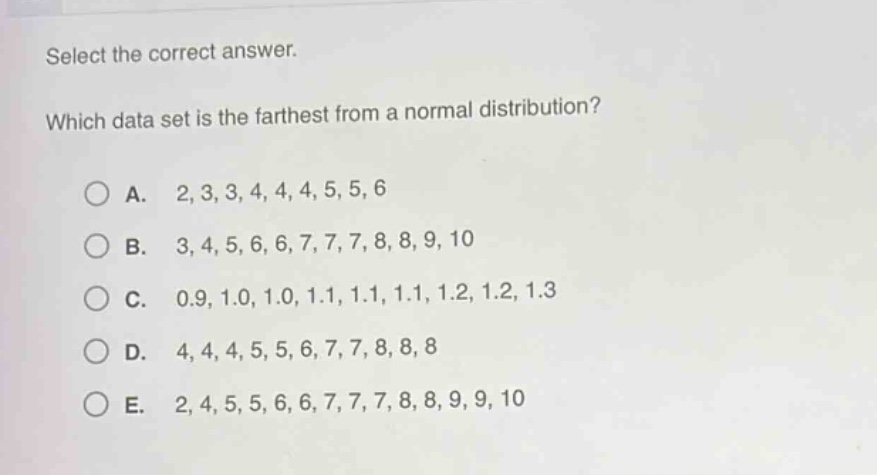
select the correct answer.\nwhich data set is the farthest from a normal distribution?\n\na. 2,3,3,4,4,4,5,5,6\n\nb. 3,4,5,6,6,7,7,7,8,8,9,10\n\nc. 0.9,1.0,1.0,1.1,1.1,1.1,1.2,1.2,1.3\n\nd. 4,4,4,5,5,6,7,7,8,8,8\n\ne. 2,4,5,5,6,6,7,7,7,8,8,9,9,10
Answer
Explanation:
Step1: Recall normal - distribution properties
A normal distribution is symmetric about the mean. We can check the symmetry of each data - set.
Step2: Analyze data - set A
Data - set A: 2, 3, 3, 4, 4, 4, 5, 5, 6. The data is somewhat symmetric around 4.
Step3: Analyze data - set B
Data - set B: 3, 4, 5, 6, 6, 7, 7, 7, 8, 8, 9, 10. It is relatively symmetric around 7.
Step4: Analyze data - set C
Data - set C: 0.9, 1.0, 1.0, 1.1, 1.1, 1.1, 1.2, 1.2, 1.3. It is symmetric around 1.1.
Step5: Analyze data - set D
Data - set D: 4, 4, 4, 5, 5, 6, 7, 7, 8, 8, 8. It is somewhat symmetric around 6.
Step6: Analyze data - set E
Data - set E: 2, 4, 5, 5, 6, 6, 7, 7, 7, 8, 8, 9, 9, 10. The left - hand side (2, 4) has a large gap compared to the right - hand side, and it is not symmetric.
Answer:
E. 2, 4, 5, 5, 6, 6, 7, 7, 7, 8, 8, 9, 9, 10