select the correct answer. if a and b are dependent events, which of these conditions must be true? a. p(a…
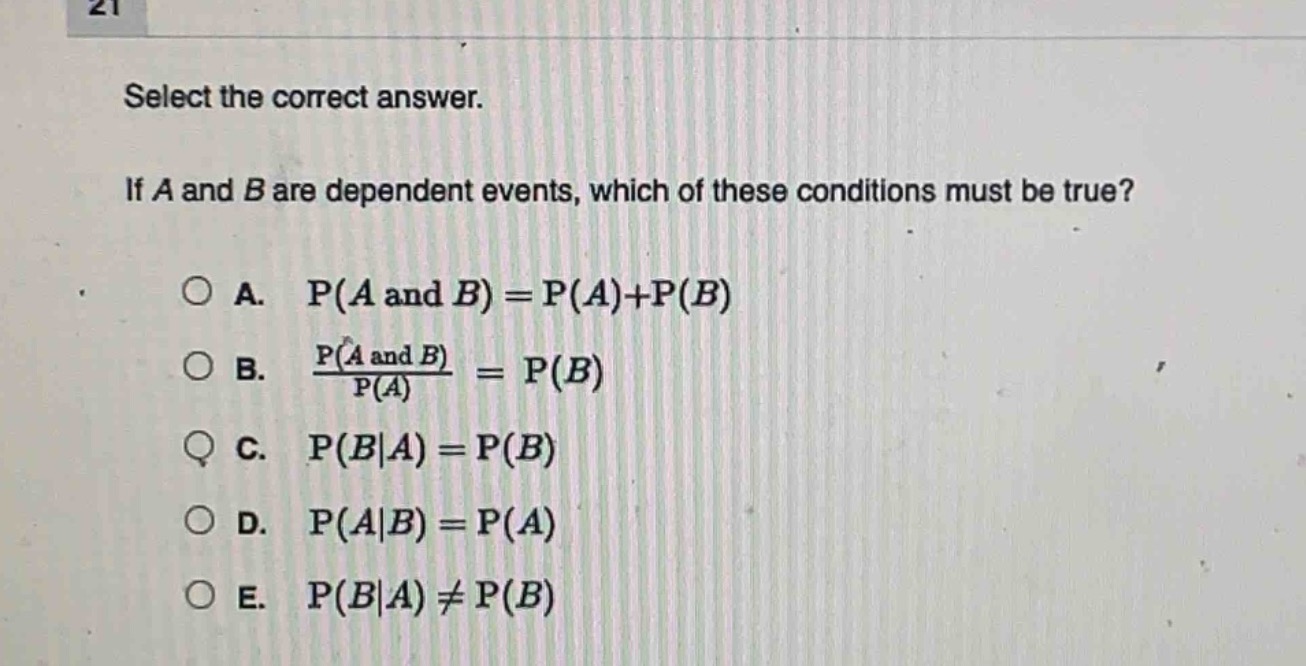
select the correct answer. if a and b are dependent events, which of these conditions must be true? a. p(a and b)=p(a)+p(b) b. $\frac{p(a\text{ and }b)}{p(a)} = p(b)$ c. p(b|a)=p(b) d. p(a|b)=p(a) e. p(b|a)≠p(b)
Answer
Explanation:
Step1: Recall definition of dependent events
Two events $A$ and $B$ are dependent if the occurrence of one event affects the probability of the other event. The formula for conditional - probability is $P(B|A)=\frac{P(A\cap B)}{P(A)}$ (where $P(A)> 0$) and $P(A|B)=\frac{P(A\cap B)}{P(B)}$ (where $P(B)> 0$). For independent events, $P(B|A) = P(B)$ and $P(A|B)=P(A)$. For dependent events, the probability of one event given the other is different from its unconditional probability.
Step2: Analyze each option
- Option A: $P(A\cap B)=P(A)+P(B)$ is the formula for mutually - exclusive events, not dependent events.
- Option B: $\frac{P(A\cap B)}{P(A)} = P(B)$ is equivalent to $P(A\cap B)=P(A)\times P(B)$, which is the condition for independent events.
- Option C: $P(B|A)=P(B)$ is the condition for independent events.
- Option D: $P(A|B)=P(A)$ is the condition for independent events.
- Option E: If $A$ and $B$ are dependent events, then the probability of $B$ given $A$ is not equal to the probability of $B$, i.e., $P(B|A)\neq P(B)$.
Answer:
E. $P(B|A)\neq P(B)$