select the correct answer from the drop - down menu. andrew took a random sample of 10 decorated ceramic…
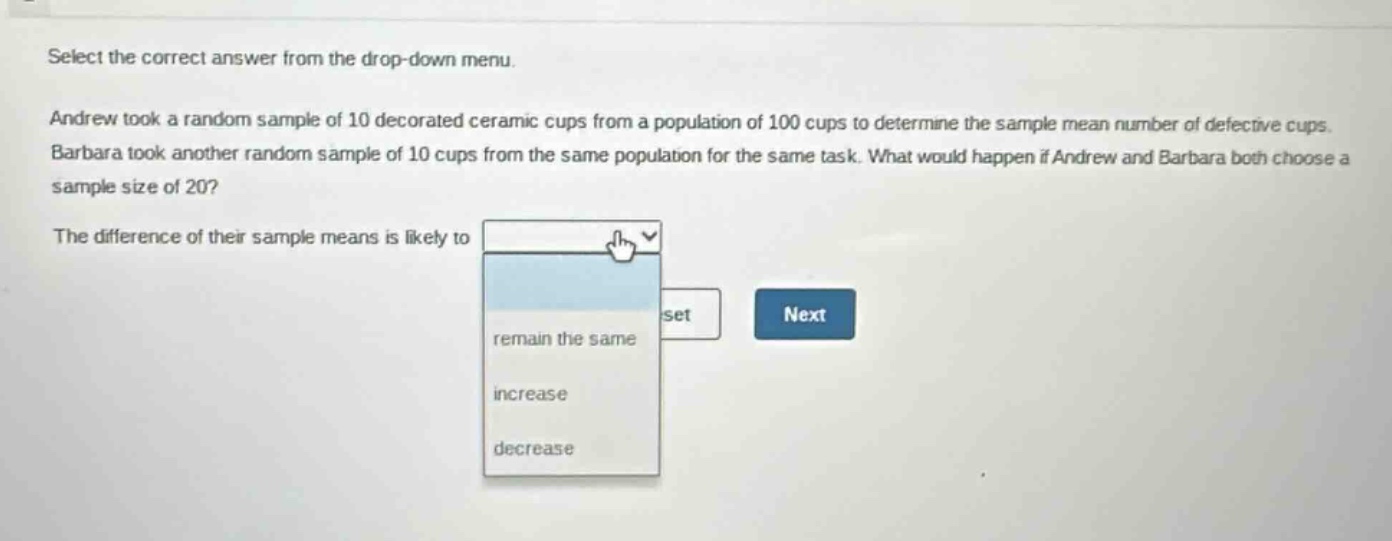
select the correct answer from the drop - down menu. andrew took a random sample of 10 decorated ceramic cups from a population of 100 cups to determine the sample mean number of defective cups. barbara took another random sample of 10 cups from the same population for the same task. what would happen if andrew and barbara both choose a sample size of 20? the difference of their sample means is likely to
Answer
Explanation:
Step1: Recall the relationship between sample size and sampling variability
As the sample size (n) increases, the standard error of the sample mean (\sigma_{\bar{x}}=\frac{\sigma}{\sqrt{n}}) (where (\sigma) is the population standard deviation) decreases. A smaller standard error means that sample means are less variable.
Step2: Analyze the effect on the difference between two sample means
When the sample size is larger (from (n = 10) to (n=20)), the sample means (\bar{x}_1) and (\bar{x}_2) (for Andrew and Barbara's samples respectively) are more likely to be close to the population mean (\mu). Mathematically, if (\bar{x}_1\approx\mu) and (\bar{x}_2\approx\mu) when (n) is large, then (|\bar{x}_1 - \bar{x}_2|) is likely to be smaller.
Answer:
decrease