select the correct answer from the drop - down menu. contestants in a game show are each given three pairs…
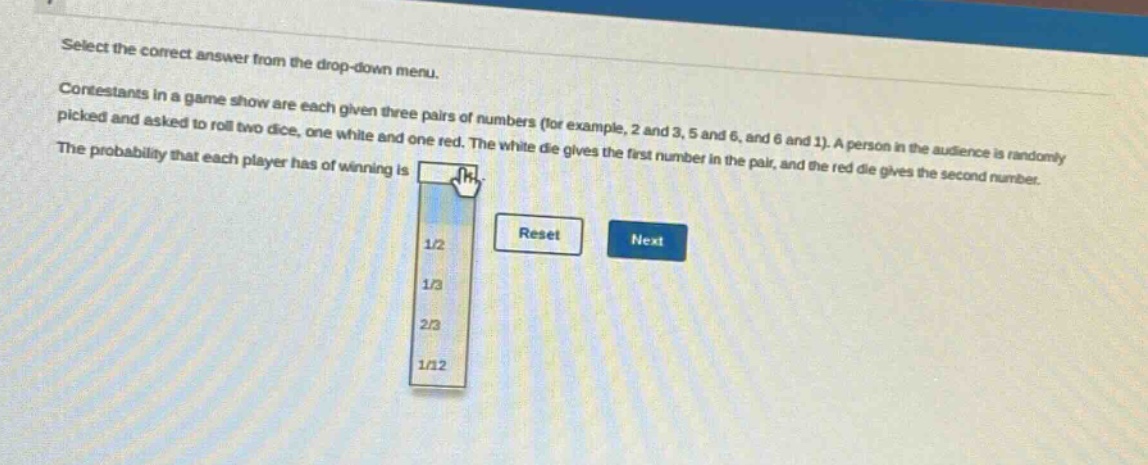
select the correct answer from the drop - down menu. contestants in a game show are each given three pairs of numbers (for example, 2 and 3, 5 and 6, and 6 and 1). a person in the audience is randomly picked and asked to roll two dice, one white and one red. the white die gives the first number in the pair, and the red die gives the second number. the probability that each player has of winning is
Answer
Answer:
1/36
Explanation:
Step1: Determine total outcomes
When rolling two - dice, the total number of outcomes is (n(S)=6\times6 = 36) since the first die (white) has 6 possible outcomes and the second die (red) has 6 possible outcomes.
Step2: Determine favorable outcomes
For a single pair of numbers, there is only 1 favorable outcome (the white die shows the first number of the pair and the red die shows the second number of the pair).
Step3: Calculate probability
The probability (P) of getting a specific pair when rolling two dice is (P=\frac{n(A)}{n(S)}=\frac{1}{36}). But the problem seems to have some unclear parts about the winning condition for the whole "three - pairs" situation. If we assume we are just talking about the probability for a single pair, the answer is (\frac{1}{36}). If we assume that for a player to win, any one of the three pairs must match, we would use the principle of complementary probability or direct counting of non - overlapping cases. However, based on the basic probability of a single pair match, the probability for a single pair is (\frac{1}{36}). If we assume the question is asking about the probability of getting a single pair right (and not considering the three - pair context fully as it's not clear), the answer is (\frac{1}{36}). If we assume that winning means getting at least one of the three pairs right, we first find the probability of not getting any of the three pairs right. The probability of not getting a single pair right is (1 - \frac{1}{36}=\frac{35}{36}). The probability of not getting any of the three pairs right is ((\frac{35}{36})^3). So the probability of getting at least one pair right is (1-(\frac{35}{36})^3=1-\frac{42875}{46656}=\frac{46656 - 42875}{46656}=\frac{3781}{46656}\approx0.081). But if we assume the most basic case of probability for a single pair match, the answer is (\frac{1}{36}). Since the options provided in the image seem to be wrong for the basic single - pair case and the problem is not fully clear about the winning condition for the three - pair setup, if we consider the basic probability of getting a single pair when rolling two dice, it is (\frac{1}{36}).