select the correct answer from each drop - down menu. stacy rolls a pair of six - sided fair dice. the…
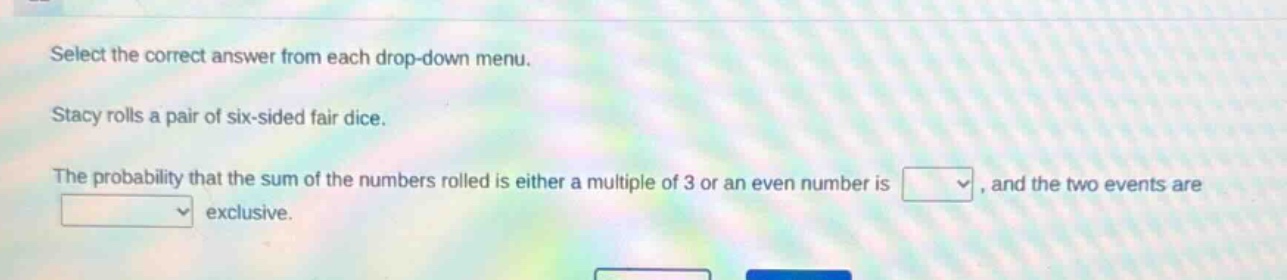
select the correct answer from each drop - down menu. stacy rolls a pair of six - sided fair dice. the probability that the sum of the numbers rolled is either a multiple of 3 or an even number is, and the two events are exclusive.
Answer
Explanation:
Step1: Find total number of outcomes
When rolling two six - sided dice, the total number of outcomes is $n(S)=6\times6 = 36$.
Step2: List outcomes for sum as multiple of 3
The possible sums that are multiples of 3 are: 3: (1,2),(2,1); 6: (1,5),(2,4),(3,3),(4,2),(5,1); 9: (3,6),(4,5),(5,4),(6,3); 12: (6,6). So $n(A)=12$.
Step3: List outcomes for sum as even number
The sum of two numbers is even if both are even or both are odd. Even - even: (2,2),(2,4),(2,6),(4,2),(4,4),(4,6),(6,2),(6,4),(6,6); Odd - odd: (1,1),(1,3),(1,5),(3,1),(3,3),(3,5),(5,1),(5,3),(5,5). So $n(B)=18$.
Step4: List outcomes for both
The sums that are both multiple of 3 and even are 6: (1,5),(2,4),(3,3),(4,2),(5,1); 12: (6,6). So $n(A\cap B)=6$.
Step5: Use the inclusion - exclusion principle
$P(A\cup B)=\frac{n(A)+n(B)-n(A\cap B)}{n(S)}=\frac{12 + 18-6}{36}=\frac{24}{36}=\frac{2}{3}$.
Step6: Check for mutual - exclusivity
Since $n(A\cap B)=6\neq0$, the two events are not mutually exclusive.
Answer:
The probability that the sum of the numbers rolled is either a multiple of 3 or an even number is $\frac{2}{3}$, and the two events are not exclusive.