select the correct answer from each drop - down menu. two six - sided fair dice are rolled simultaneously…
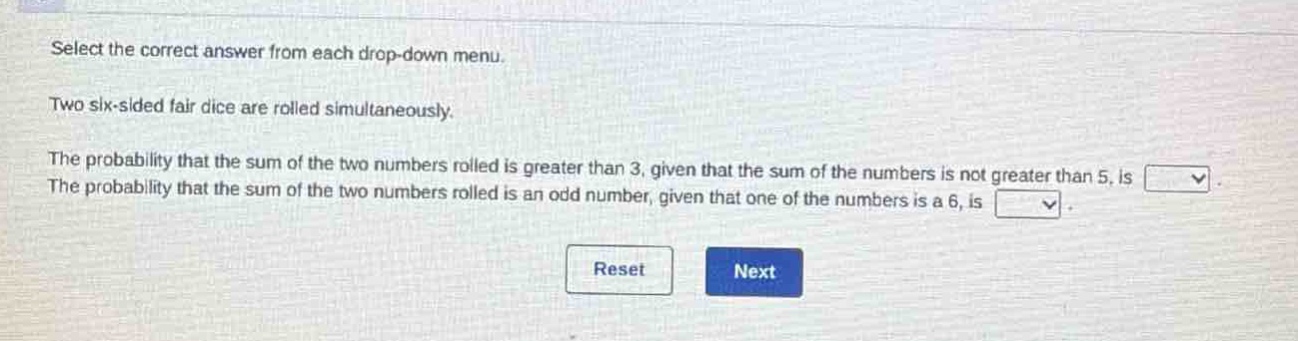
select the correct answer from each drop - down menu. two six - sided fair dice are rolled simultaneously. the probability that the sum of the two numbers rolled is greater than 3, given that the sum of the numbers is not greater than 5, is. the probability that the sum of the two numbers rolled is an odd number, given that one of the numbers is a 6, is.
Answer
Explanation:
Step1: Find total outcomes
When two six - sided dice are rolled, the total number of outcomes is $n(S)=6\times6 = 36$.
Step2: Define events for first part
Let $A$ be the event that the sum of the two numbers is greater than 3 and $B$ be the event that the sum of the two numbers is not greater than 5. The possible sums not greater than 5 are 2, 3, 4, 5. The pairs for sum = 2: $(1,1)$; sum = 3: $(1,2),(2,1)$; sum = 4: $(1,3),(3,1),(2,2)$; sum = 5: $(1,4),(4,1),(2,3),(3,2)$. So $n(B)=1 + 2+3 + 4=10$. The pairs in $B$ that also satisfy $A$ (sum > 3) are the pairs with sum 4 and 5, so $n(A\cap B)=3 + 4 = 7$. By the formula for conditional probability $P(A|B)=\frac{n(A\cap B)}{n(B)}$, we have $P(A|B)=\frac{7}{10}$.
Step3: Define events for second part
Let $C$ be the event that the sum of the two numbers is an odd number and $D$ be the event that one of the numbers is a 6. The pairs where one of the numbers is 6 are: $(1,6),(2,6),(3,6),(4,6),(5,6),(6,1),(6,2),(6,3),(6,4),(6,5),(6,6)$. So $n(D)=11$. The pairs in $D$ where the sum is odd are: $(1,6),(3,6),(5,6),(6,1),(6,3),(6,5)$. So $n(C\cap D)=6$. By the formula for conditional probability $P(C|D)=\frac{n(C\cap D)}{n(D)}$, we have $P(C|D)=\frac{6}{11}$.
Answer:
The probability that the sum of the two numbers rolled is greater than 3, given that the sum of the numbers is not greater than 5, is $\frac{7}{10}$. The probability that the sum of the two numbers rolled is an odd number, given that one of the numbers is a 6, is $\frac{6}{11}$.