select the correct answer.\nan experiment consists of rolling a six - sided die to select a number between 1…
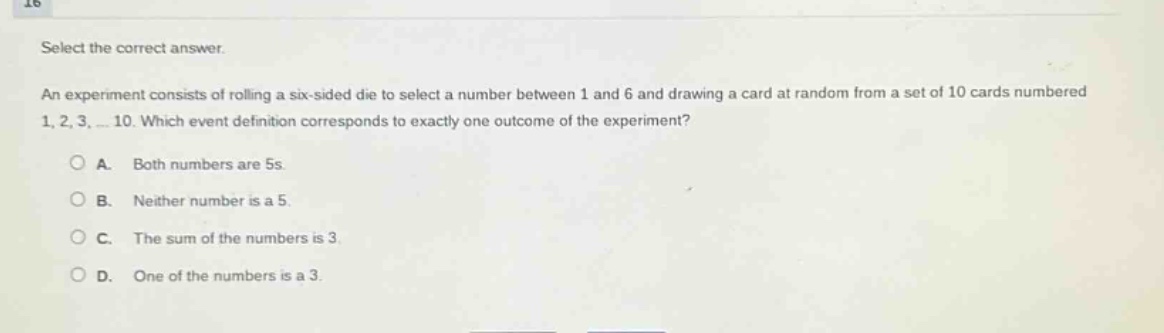
select the correct answer.\nan experiment consists of rolling a six - sided die to select a number between 1 and 6 and drawing a card at random from a set of 10 cards numbered 1, 2, 3, … 10. which event definition corresponds to exactly one outcome of the experiment?\na. both numbers are 5s.\nb. neither number is a 5.\nc. the sum of the numbers is 3.\nd. one of the numbers is a 3.
Answer
Explanation:
Step1: Understand the experiment
The experiment has two - part: rolling a 6 - sided die (6 possible outcomes) and drawing a card from 10 - card set (10 possible outcomes), so there are (6\times10 = 60) total possible outcomes. An outcome is a specific combination of the die - roll result and the card - draw result.
Step2: Analyze each option
- Option A: "Both numbers are 5s" means the die shows 5 and the card shows 5. This is a single specific combination out of the 60 possible outcomes.
- Option B: "Neither number is a 5" has multiple combinations. For the die, there are 5 non - 5 values (1, 2, 3, 4, 6), and for the card, there are 9 non - 5 values (1, 2, 3, 4, 6, 7, 8, 9, 10). So, there are (5\times9=45) combinations, not a single outcome.
- Option C: "The sum of the numbers is 3". The possible pairs are (1, 2) and (2, 1), so there are 2 combinations, not a single outcome.
- Option D: "One of the numbers is a 3". There are multiple combinations where either the die shows 3 or the card shows 3 or both, so it is not a single outcome.
Answer:
A. Both numbers are 5s.