select the correct answer.\na fair, unbiased coin was flipped 10 times, giving the results shown in the…
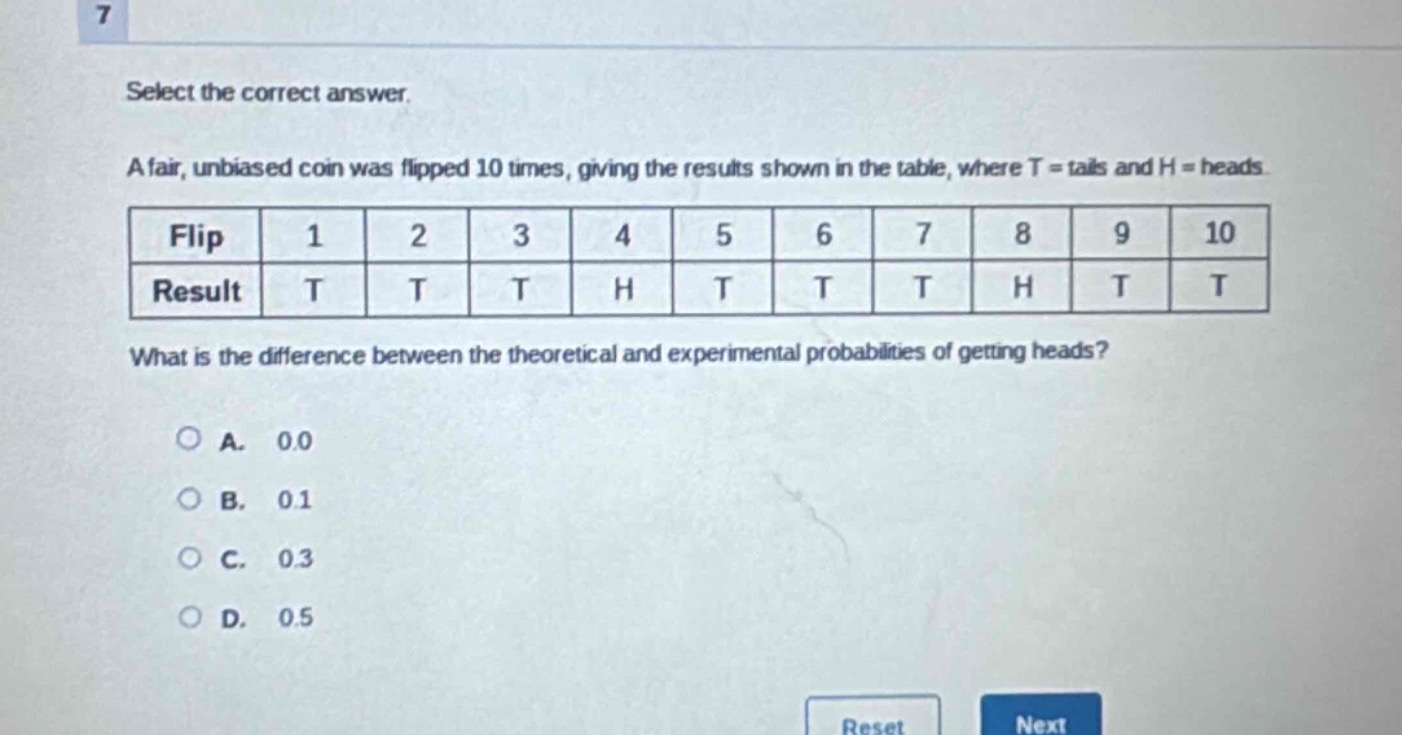
select the correct answer.\na fair, unbiased coin was flipped 10 times, giving the results shown in the table, where t = tails and h = heads.\n| flip | 1 | 2 | 3 | 4 | 5 | 6 | 7 | 8 | 9 | 10 |\n| result | t | t | t | h | t | t | t | h | t | t |\nwhat is the difference between the theoretical and experimental probabilities of getting heads?\na. 0.0\nb. 0.1\nc. 0.3\nd. 0.5
Answer
Answer:
C. 0.3
Explanation:
Step1: Calculate theoretical probability
For a fair coin, $P(H)=\frac{1}{2}=0.5$
Step2: Calculate experimental probability
There are 2 heads in 10 flips. So $P_{exp}(H)=\frac{2}{10} = 0.2$
Step3: Find the difference
$|0.5 - 0.2|=0.3$