select the correct answer.\na game involves rolling a fair six - sided die. if the number facing upward on…
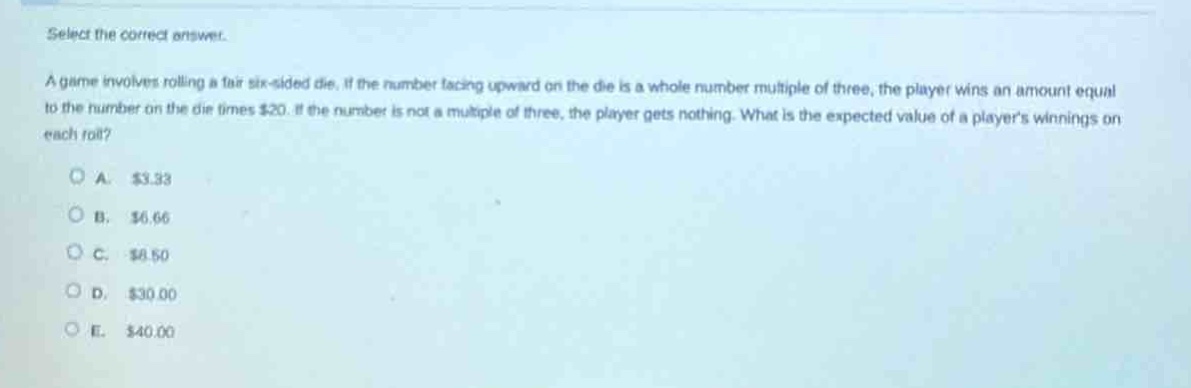
select the correct answer.\na game involves rolling a fair six - sided die. if the number facing upward on the die is a whole number multiple of three, the player wins an amount equal to the number on the die times $20. if the number is not a multiple of three, the player gets nothing. what is the expected value of a players winnings on each roll?\na. $3.33\nb. $6.66\nc. $8.50\nd. $30.00\ne. $40.00
Answer
Explanation:
Step1: Identify winning numbers and their probabilities
A six - sided die has values 1, 2, 3, 4, 5, 6. The multiples of 3 are 3 and 6. The probability of rolling a 3 or 6 is $\frac{2}{6}=\frac{1}{3}$, and the probability of rolling a non - multiple of 3 (1, 2, 4, 5) is $\frac{4}{6}=\frac{2}{3}$.
Step2: Calculate the pay - offs for winning numbers
If the number is 3, the pay - off is $3\times20 = 60$. If the number is 6, the pay - off is $6\times20=120$.
Step3: Use the expected value formula
The expected value $E(X)$ of a discrete random variable is given by $E(X)=\sum_{i}x_ip_i$. Here, $x_1 = 60$, $p_1=\frac{1}{6}$ (probability of rolling a 3), $x_2 = 120$, $p_2=\frac{1}{6}$ (probability of rolling a 6), and for non - winning cases $x = 0$ with probability $\frac{2}{3}$. $E(X)=(60\times\frac{1}{6})+(120\times\frac{1}{6})+(0\times\frac{2}{3})=10 + 20+0=30$.
Answer:
D. $30.00$