select the correct answer.\na game involves rolling a fair six - sided die. if the number obtained on the…
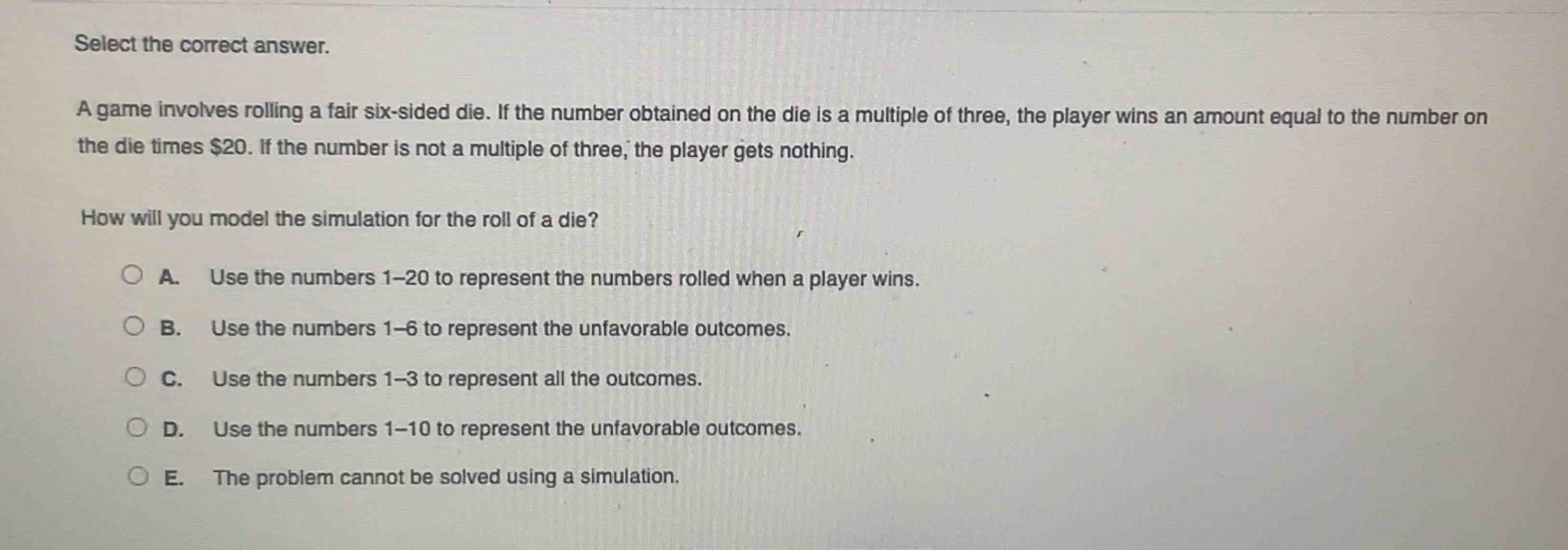
select the correct answer.\na game involves rolling a fair six - sided die. if the number obtained on the die is a multiple of three, the player wins an amount equal to the number on the die times $20. if the number is not a multiple of three, the player gets nothing.\nhow will you model the simulation for the roll of a die?\n○ a. use the numbers 1 - 20 to represent the numbers rolled when a player wins.\n○ b. use the numbers 1 - 6 to represent the unfavorable outcomes.\n○ c. use the numbers 1 - 3 to represent all the outcomes.\n○ d. use the numbers 1 - 10 to represent the unfavorable outcomes.\n○ e. the problem cannot be solved using a simulation.
Answer
Explanation:
Step1: Analyze favorable and unfavorable outcomes
A fair six - sided die has outcomes 1, 2, 3, 4, 5, 6. The multiples of three (favorable outcomes) are 3 and 6. The non - multiples of three (unfavorable outcomes) are 1, 2, 4, 5.
Step2: Evaluate each option
- Option A: Using 1 - 20 to represent winning numbers is incorrect as there are only 2 winning numbers (3 and 6) out of 6 possible die outcomes.
- Option B: Using 1 - 6 to represent unfavorable outcomes is wrong because only 4 out of 6 outcomes are unfavorable.
- Option C: Using 1 - 3 to represent all outcomes is incorrect since there are 6 possible outcomes on a die.
- Option D: We can assign 1 - 10 to represent unfavorable outcomes. We can assume that if a random number generator gives a number from 1 - 10, it represents an unfavorable outcome. And if it gives a number from 11 - 20 (for example), it can represent favorable outcomes. This is a valid way to model the simulation.
- Option E: The problem can be solved using a simulation.
Answer:
D. Use the numbers 1 - 10 to represent the unfavorable outcomes.