select the correct answer.\njerry has taken a random sample of students and determined the number of…
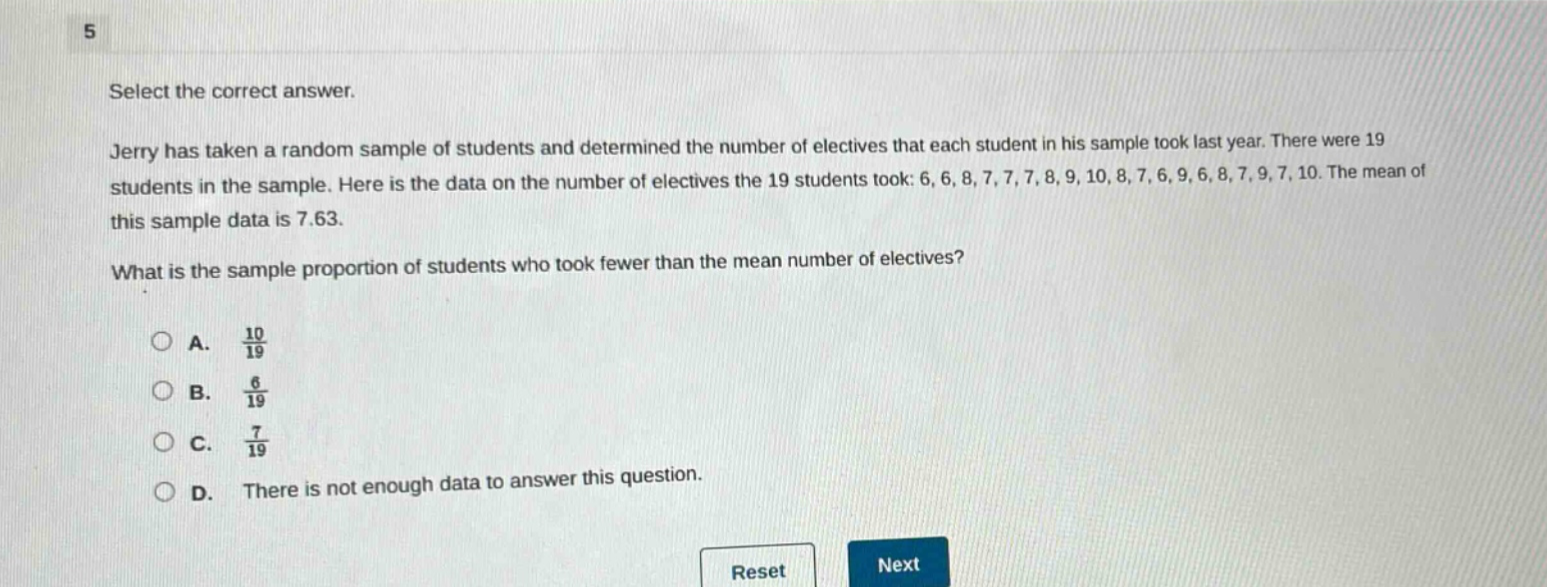
select the correct answer.\njerry has taken a random sample of students and determined the number of electives that each student in his sample took last year. there were 19 students in the sample. here is the data on the number of electives the 19 students took: 6, 6, 8, 7, 7, 7, 8, 9, 10, 8, 7, 6, 9, 6, 8, 7, 9, 7, 10. the mean of this sample data is 7.63.\nwhat is the sample proportion of students who took fewer than the mean number of electives?\na. $\frac{10}{19}$\nb. $\frac{6}{19}$\nc. $\frac{7}{19}$\nd. there is not enough data to answer this question.
Answer
Explanation:
Step1: Count the number of students who took fewer than the mean
The mean is (7.63). The data values are: (6,6,8,7,7,7,8,9,10,8,7,6,9,6,8,7,9,7,10). The values less than (7.63) are (6,6,7,7,7,7,6,6,7,7). Counting these, we find there are (10) such values.
Step2: Calculate the sample proportion
The sample proportion (p=\frac{\text{Number of students with fewer than mean}}{\text{Total number of students}}). Here, the total number of students (n = 19) and the number of students with fewer than the mean is (10). So (p=\frac{10}{19}).
Answer:
A. (\frac{10}{19})