select the correct answer.\njims sock drawer has two pairs of black socks, three pairs of white, one pair of…
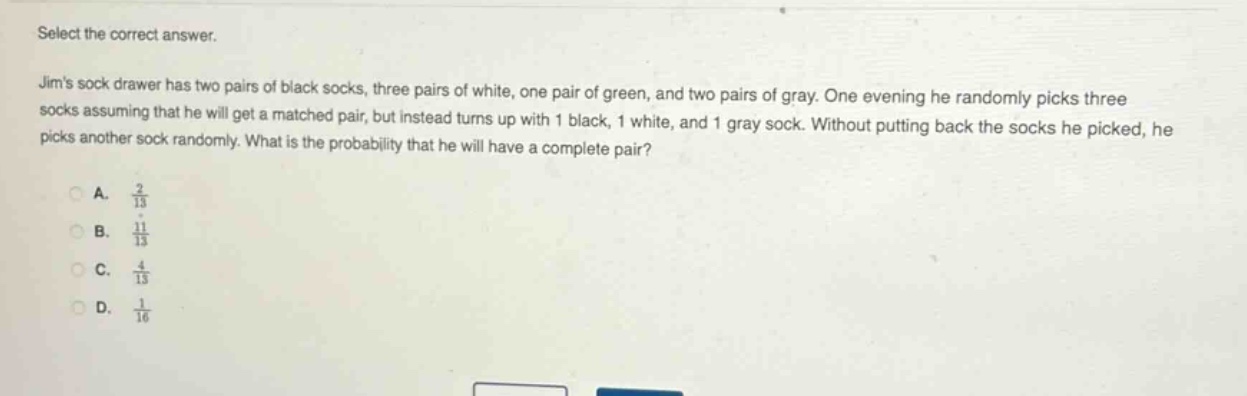
select the correct answer.\njims sock drawer has two pairs of black socks, three pairs of white, one pair of green, and two pairs of gray. one evening he randomly picks three socks assuming that he will get a matched pair, but instead turns up with 1 black, 1 white, and 1 gray sock. without putting back the socks he picked, he picks another sock randomly. what is the probability that he will have a complete pair?\na. $\frac{2}{13}$\nb. $\frac{11}{13}$\nc. $\frac{4}{13}$\nd. $\frac{1}{16}$
Answer
Answer:
C. $\frac{4}{13}$
Explanation:
Step1: Calculate total number of socks initially
There are $(2 + 3+1 + 2)\times2= 16$ socks initially.
Step2: Calculate remaining number of socks
After picking 3 socks, there are $16 - 3=13$ socks left.
Step3: Determine favorable outcomes
He has 1 black, 1 white and 1 gray sock already. To get a pair, he needs to pick either a black, white or gray sock. There are $2\times2 - 1+3\times2 - 1+2\times2 - 1 = 4 + 5+3=4$ socks among the remaining 13 that will complete a pair. So the probability is $\frac{4}{13}$.