select the correct answer. which statement is true? a. a sample statistic can never be equal to the…
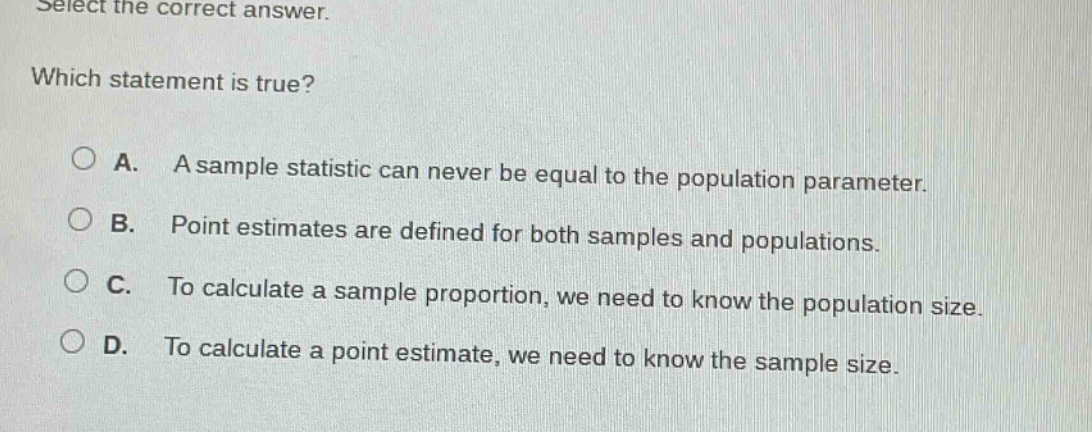
select the correct answer. which statement is true? a. a sample statistic can never be equal to the population parameter. b. point estimates are defined for both samples and populations. c. to calculate a sample proportion, we need to know the population size. d. to calculate a point estimate, we need to know the sample size.
Answer
Brief Explanations:
- Option A: It is possible for a sample statistic to equal the population parameter by chance, so this is false.
- Option B: Point - estimates are for samples, not populations. A population has parameters, not point - estimates. So this is false.
- Option C: To calculate a sample proportion, we only need to know the number of successes in the sample and the sample size, not the population size. So this is false.
- Option D: To calculate a point estimate (e.g., sample mean, sample proportion), we need to know the sample size as it is part of the calculation formula. For example, sample mean $\bar{x}=\frac{\sum_{i = 1}^{n}x_{i}}{n}$, where $n$ is the sample size. So this is true.
Answer:
D. To calculate a point estimate, we need to know the sample size.