select the correct answer. the venn diagram shows event a and event b comprised of outcomes from the same…
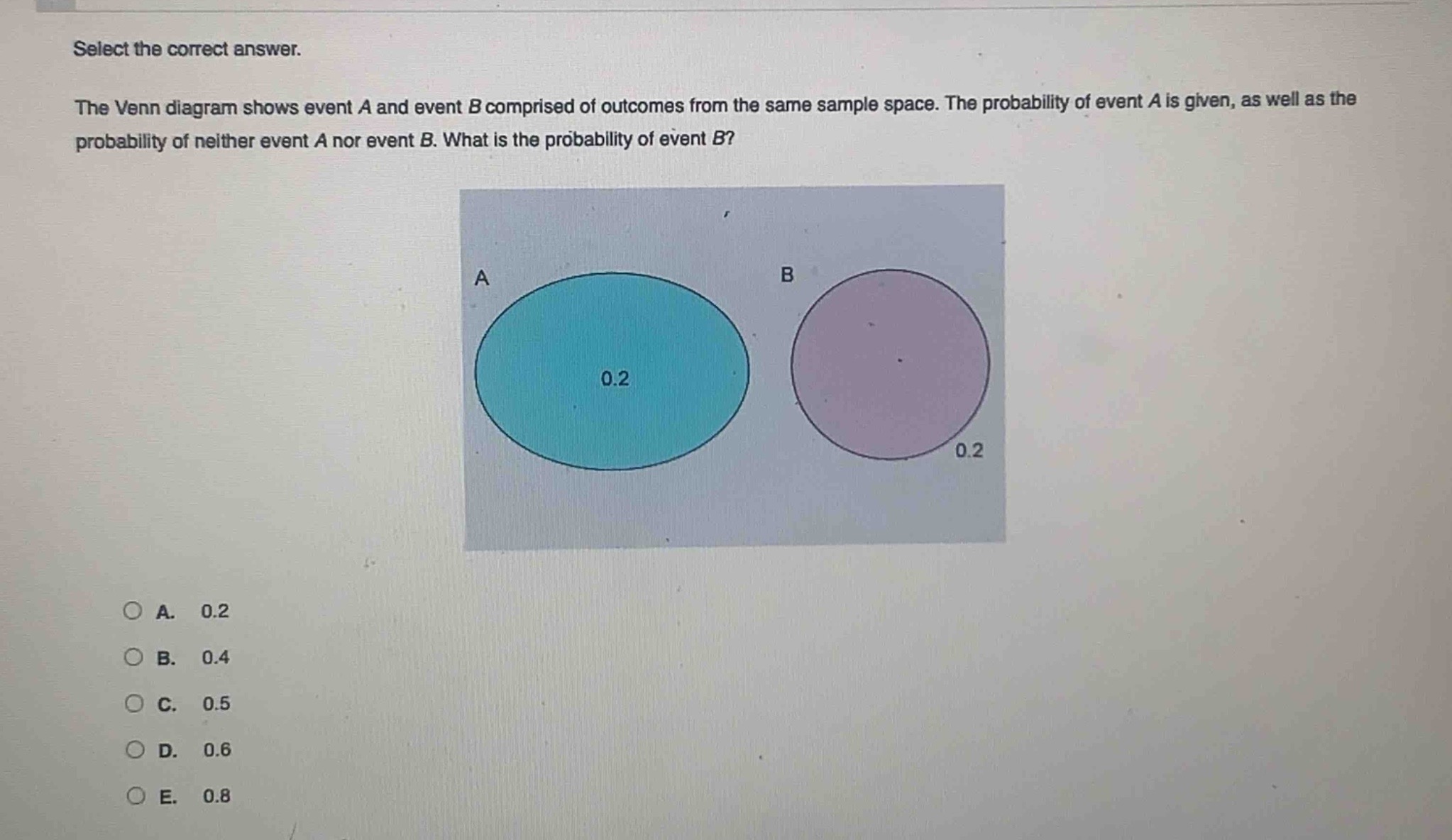
select the correct answer. the venn diagram shows event a and event b comprised of outcomes from the same sample space. the probability of event a is given, as well as the probability of neither event a nor event b. what is the probability of event b? a. 0.2 b. 0.4 c. 0.5 d. 0.6 e. 0.8
Answer
Explanation:
Step1: Recall probability formula
The sum of probabilities of all possible outcomes is 1. Let (P(A) = 0.2) and (P(\text{neither }A\text{ nor }B)=0.2). Let (P(B)=x). Since (A) and (B) are mutually - exclusive (disjoint as there is no overlap in the Venn - diagram), (P(A\cup B)=P(A)+P(B)). And (P(A\cup B)+P(\text{neither }A\text{ nor }B)=1).
Step2: Substitute values
We know that (P(A)+P(B)+P(\text{neither }A\text{ nor }B)=1). Substituting (P(A) = 0.2) and (P(\text{neither }A\text{ nor }B)=0.2) into the equation, we get (0.2 + x+0.2=1).
Step3: Solve for (x)
First, simplify the left - hand side of the equation: (0.4 + x=1). Then subtract 0.4 from both sides: (x=1 - 0.4). So (x = 0.6).
Answer:
D. 0.6