select all the correct answers.\nthe isotope silicon - 32 decays into phosphorus - 32. silicon - 32 has a…
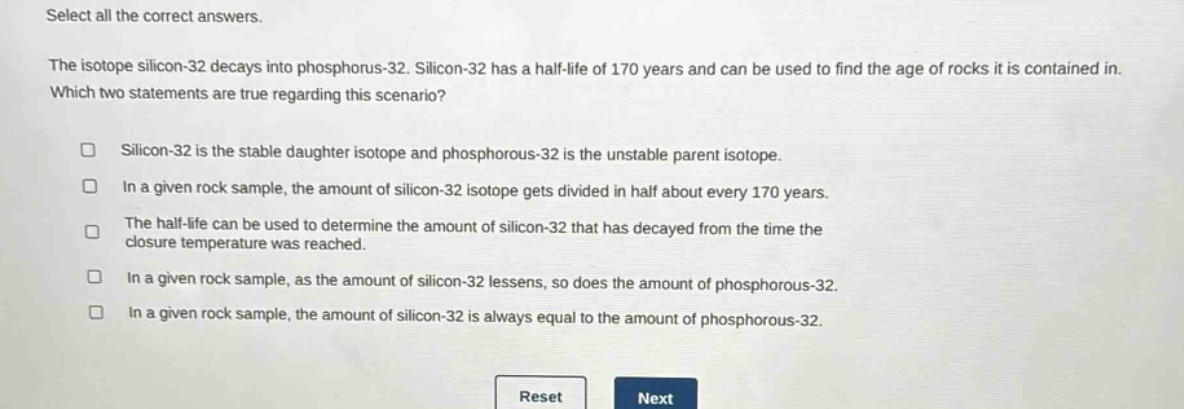
select all the correct answers.\nthe isotope silicon - 32 decays into phosphorus - 32. silicon - 32 has a half - life of 170 years and can be used to find the age of rocks it is contained in.\nwhich two statements are true regarding this scenario?\n□ silicon - 32 is the stable daughter isotope and phosphorous - 32 is the unstable parent isotope.\n□ in a given rock sample, the amount of silicon - 32 isotope gets divided in half about every 170 years.\n□ the half - life can be used to determine the amount of silicon - 32 that has decayed from the time the closure temperature was reached.\n□ in a given rock sample, as the amount of silicon - 32 lessens, so does the amount of phosphorous - 32.\n□ in a given rock sample, the amount of silicon - 32 is always equal to the amount of phosphorous - 32.\nreset next
Answer
Brief Explanations:
- The half - life of an isotope is the time it takes for half of the amount of that isotope to decay. So, for silicon - 32 with a half - life of 170 years, in a given rock sample, the amount of silicon - 32 isotope gets divided in half about every 170 years.
- The half - life can be used in radiometric dating to determine the amount of an isotope that has decayed since the closure temperature (when the system became closed to the exchange of the isotope) was reached.
- Silicon - 32 is the parent isotope and phosphorus - 32 is the daughter isotope. As silicon - 32 decays, the amount of phosphorus - 32 increases. And the amounts of the two are not always equal.
Answer:
- In a given rock sample, the amount of silicon-32 isotope gets divided in half about every 170 years.
- The half - life can be used to determine the amount of silicon-32 that has decayed from the time the closure temperature was reached.