a shoe company wants to determine if the new tread on its top line of running shoes lasts longer than the…
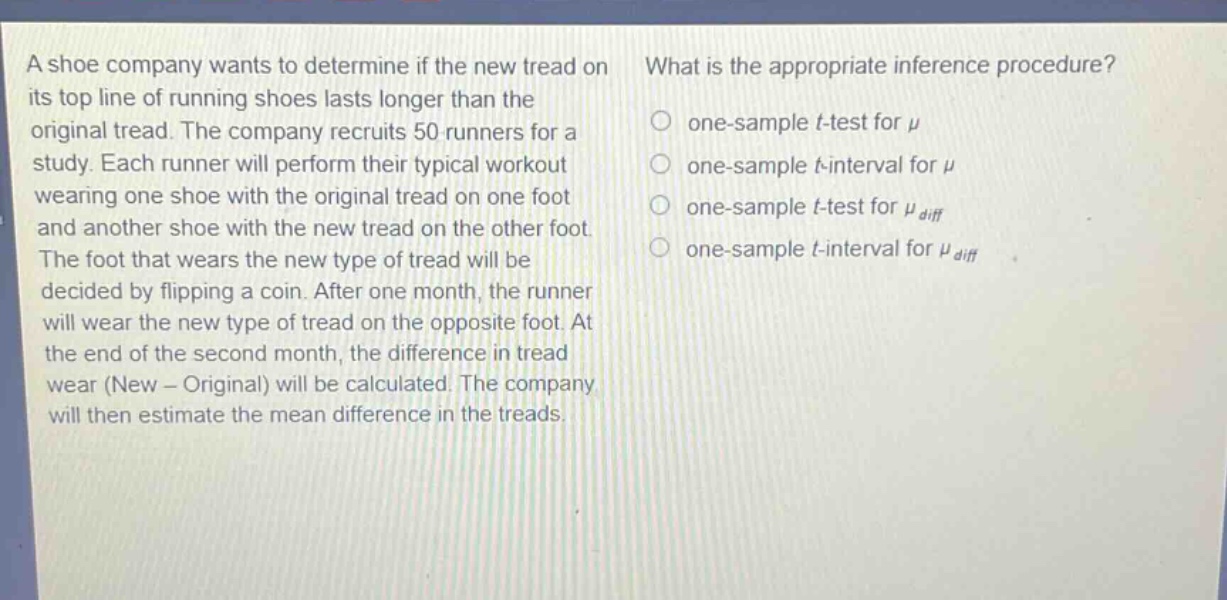
a shoe company wants to determine if the new tread on its top line of running shoes lasts longer than the original tread. the company recruits 50 runners for a study. each runner will perform their typical workout wearing one shoe with the original tread on one foot and another shoe with the new tread on the other foot. the foot that wears the new type of tread will be decided by flipping a coin. after one month, the runner will wear the new type of tread on the opposite foot. at the end of the second month, the difference in tread wear (new - original) will be calculated. the company will then estimate the mean difference in the treads. what is the appropriate inference procedure? one - sample t - test for $mu$ one - sample t - interval for $mu$ one - sample t - test for $mu_{diff}$ one - sample t - interval for $mu_{diff}$
Answer
Brief Explanations:
The company wants to estimate the mean difference in tread wear between the new and original treads. Paired - data is used (each runner has measurements for both treads on different feet at different times). An interval is needed for estimation. So, a one - sample t - interval for $\mu_{diff}$ is appropriate as it will give an interval estimate for the population mean difference.
Answer:
one - sample t - interval for $\mu_{diff}$