a shoe company wants to determine if the new tread on its top line of running shoes lasts longer than the…
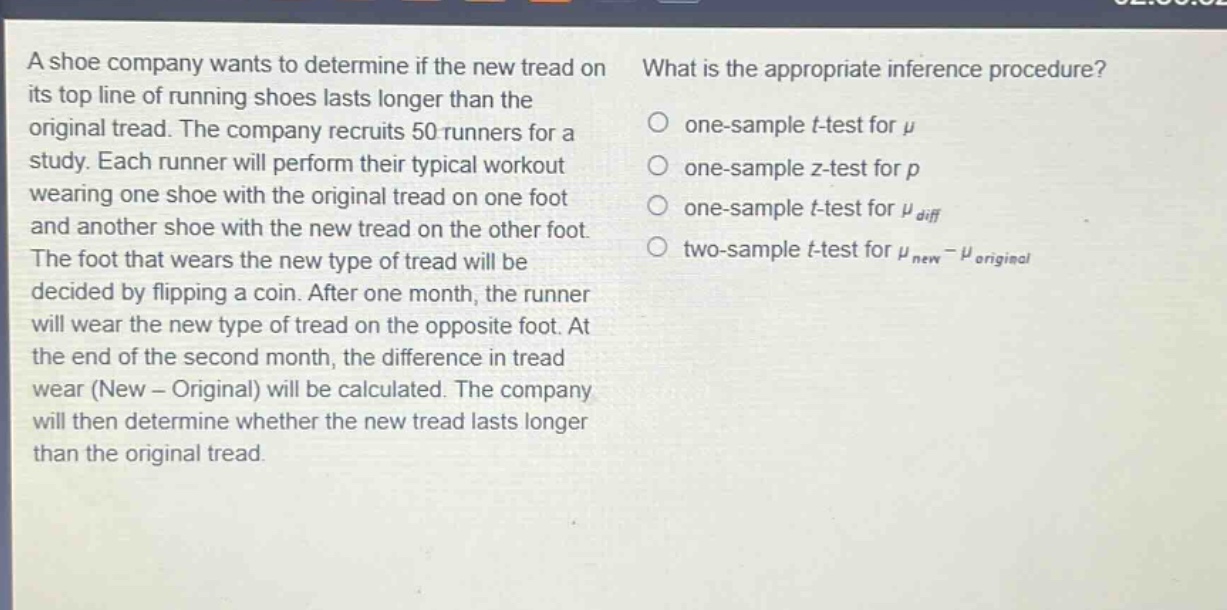
a shoe company wants to determine if the new tread on its top line of running shoes lasts longer than the original tread. the company recruits 50 runners for a study. each runner will perform their typical workout wearing one shoe with the original tread on one foot and another shoe with the new tread on the other foot. the foot that wears the new type of tread will be decided by flipping a coin. after one month, the runner will wear the new type of tread on the opposite foot. at the end of the second month, the difference in tread wear (new - original) will be calculated. the company will then determine whether the new tread lasts longer than the original tread. what is the appropriate inference procedure? one - sample t - test for $mu$ one - sample z - test for $p$ one - sample t - test for $mu_{diff}$ two - sample t - test for $mu_{new}-mu_{original}$
Answer
Explanation:
Step1: Identify the data - type
The data consists of paired observations (tread - wear on the same runner's two feet with different treads at different times).
Step2: Recall the inference procedures
For paired data, we use a one - sample t - test on the differences. Here, we are interested in the difference in tread wear (New - Original) for each runner.
Answer:
one - sample t - test for $\mu_{diff}$