a simple random sample of size n = 61 is obtained from a population that is skewed left with μ = 33 and σ =…
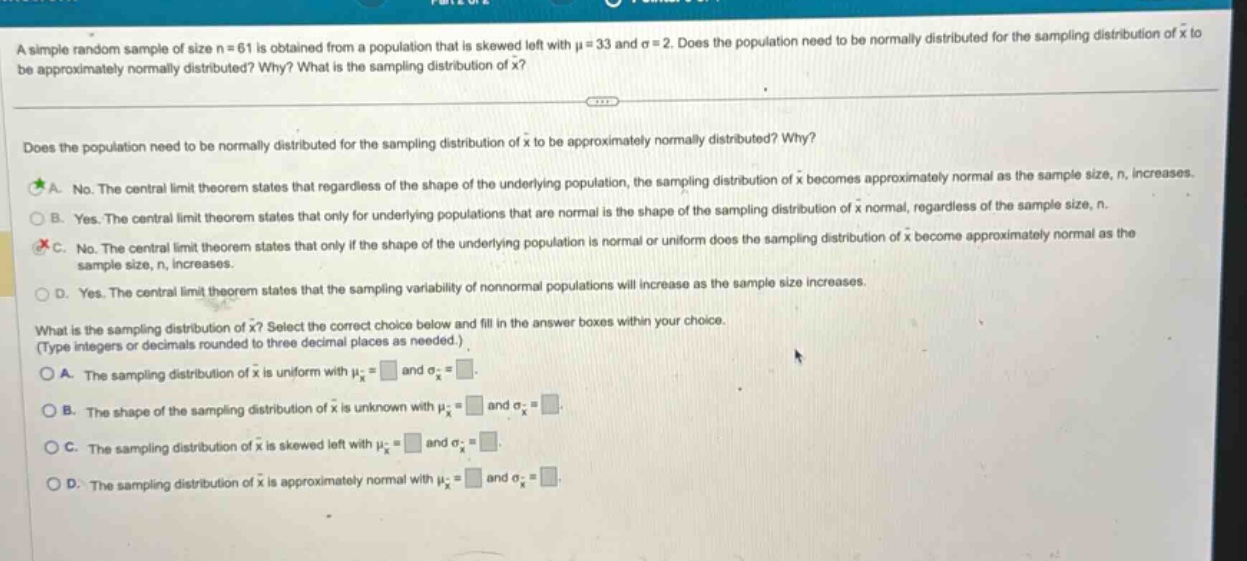
a simple random sample of size n = 61 is obtained from a population that is skewed left with μ = 33 and σ = 2. does the population need to be normally distributed for the sampling distribution of x̅ to be approximately normally distributed? why? what is the sampling distribution of x̅?\n\ndoes the population need to be normally distributed for the sampling distribution of x̅ to be approximately normally distributed? why?\na. no. the central limit theorem states that regardless of the shape of the underlying population, the sampling distribution of x̅ becomes approximately normal as the sample size, n, increases.\nb. yes. the central limit theorem states that only for underlying populations that are normal is the shape of the sampling distribution of x̅ normal, regardless of the sample size, n.\nc. no. the central limit theorem states that only if the shape of the underlying population is normal or uniform does the sampling distribution of x̅ become approximately normal as the sample size, n, increases.\nd. yes. the central limit theorem states that the sampling variability of non - normal populations will increase as the sample size increases.\n\nwhat is the sampling distribution of x̅? select the correct choice below and fill in the answer boxes within your choice. (type integers or decimals rounded to three decimal places as needed.)\na. the sampling distribution of x̅ is uniform with μ_x̅ = □ and σ_x̅ = □.\nb. the shape of the sampling distribution of x̅ is unknown with μ_x̅ = □ and σ_x̅ = □.\nc. the sampling distribution of x̅ is skewed left with μ_x̅ = □ and σ_x̅ = □.\nd. the sampling distribution of x̅ is approximately normal with μ_x̅ = □ and σ_x̅ = □.
Answer
Explanation:
Step1: Recall central limit theorem
The central limit theorem states that for a sample of size $n$ from any population (regardless of shape), as $n$ gets large (usually $n\geq30$), the sampling - distribution of the sample mean $\bar{x}$ is approximately normal. Here, $n = 61\geq30$.
Step2: Determine mean and standard deviation of sampling distribution
The mean of the sampling distribution of the sample mean $\mu_{\bar{x}}$ is equal to the population mean $\mu$. So, $\mu_{\bar{x}}=\mu = 33$. The standard deviation of the sampling distribution of the sample mean (also known as the standard error) is given by $\sigma_{\bar{x}}=\frac{\sigma}{\sqrt{n}}$, where $\sigma$ is the population standard deviation and $n$ is the sample size. Substituting $\sigma = 2$ and $n = 61$, we get $\sigma_{\bar{x}}=\frac{2}{\sqrt{61}}\approx\frac{2}{7.810}\approx0.256$.
Answer:
A. No. The central limit theorem states that regardless of the shape of the underlying population, the sampling distribution of $\bar{x}$ becomes approximately normal as the sample size, $n$, increases. D. The sampling distribution of $\bar{x}$ is approximately normal with $\mu_{\bar{x}} = 33$ and $\sigma_{\bar{x}}\approx0.256$.