a single die is rolled twice. find the probability of rolling an even number the first time and a number…
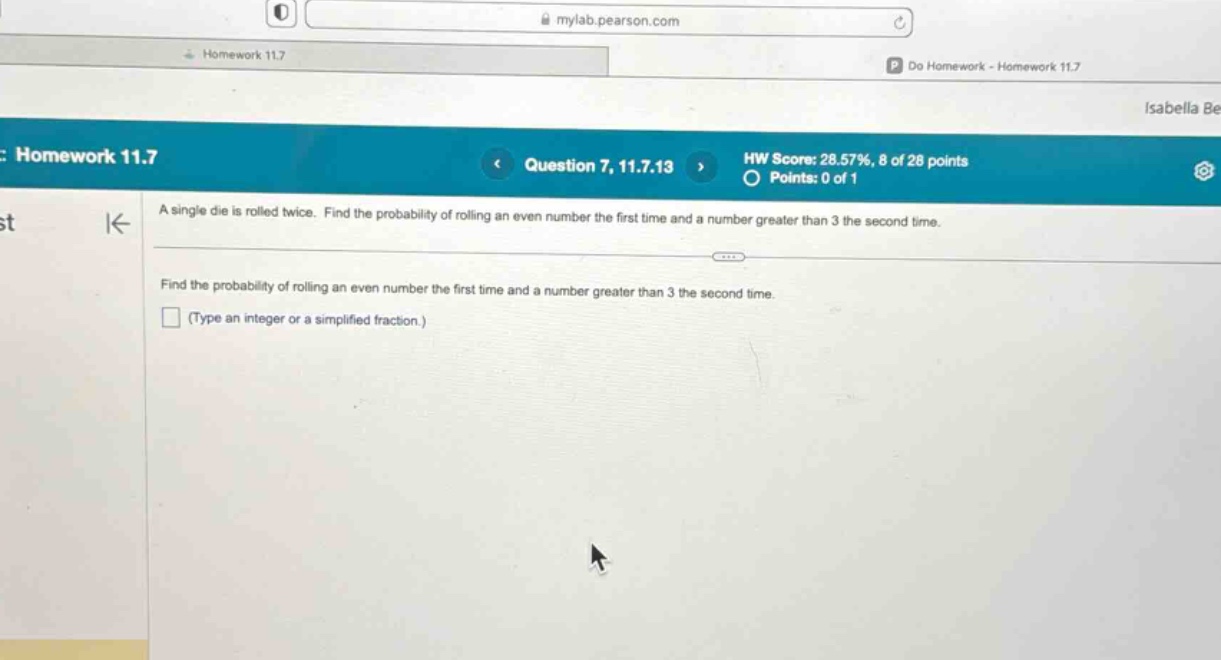
a single die is rolled twice. find the probability of rolling an even number the first time and a number greater than 3 the second time.\nfind the probability of rolling an even number the first time and a number greater than 3 the second time.\n(type an integer or a simplified fraction.)
Answer
Explanation:
Step1: Calculate probability of rolling an even - number first
A die has 6 faces numbered from 1 to 6. The even numbers are 2, 4, 6. So the number of favorable outcomes for rolling an even number is 3. The probability $P(A)$ of rolling an even number on the first roll is $P(A)=\frac{3}{6}=\frac{1}{2}$.
Step2: Calculate probability of rolling a number greater than 3 second
The numbers greater than 3 on a die are 4, 5, 6. So the number of favorable outcomes for rolling a number greater than 3 is 3. The probability $P(B)$ of rolling a number greater than 3 on the second roll is $P(B)=\frac{3}{6}=\frac{1}{2}$.
Step3: Use the multiplication rule for independent events
Since the two rolls of the die are independent events, the probability of both events occurring is $P(A\cap B)=P(A)\times P(B)$. Substituting the values of $P(A)$ and $P(B)$ we found above, we get $P(A\cap B)=\frac{1}{2}\times\frac{1}{2}=\frac{1}{4}$.
Answer:
$\frac{1}{4}$