a six - sided number cube is rolled 300 times. the results are 120 even numbers and 180 odd numbers. how…
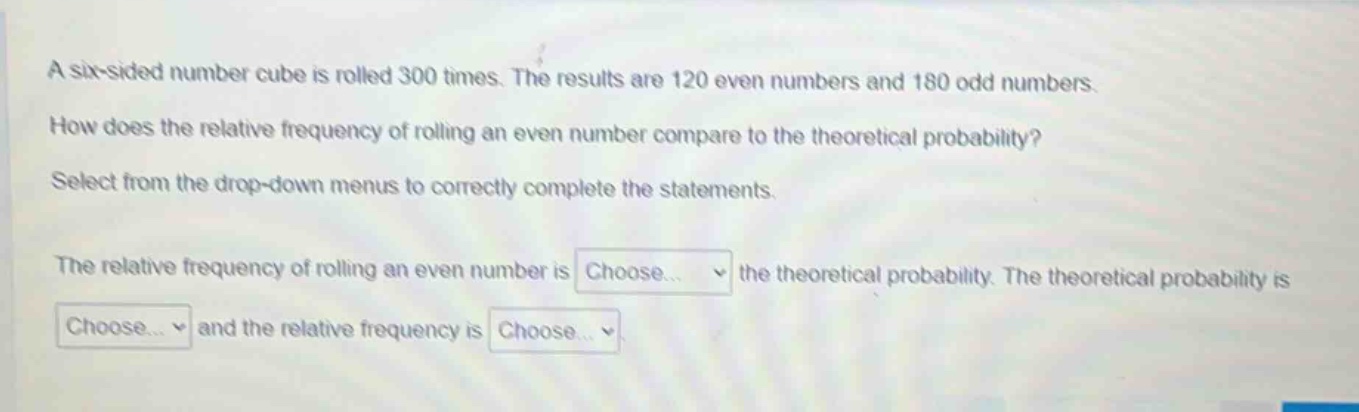
a six - sided number cube is rolled 300 times. the results are 120 even numbers and 180 odd numbers. how does the relative frequency of rolling an even number compare to the theoretical probability? select from the drop - down menus to correctly complete the statements. the relative frequency of rolling an even number is choose... the theoretical probability. the theoretical probability is choose... and the relative frequency is choose...
Answer
Explanation:
Step1: Calculate theoretical probability
A six - sided die has 3 even numbers (2, 4, 6) out of 6 total numbers. So the theoretical probability $P_{theo}$ of rolling an even number is $P_{theo}=\frac{3}{6}=\frac{1}{2}=0.5$.
Step2: Calculate relative frequency
The relative frequency $P_{rel}$ of rolling an even number is the number of times an even number is rolled divided by the total number of rolls. Given 120 even - number rolls out of 300 total rolls, $P_{rel}=\frac{120}{300}=0.4$.
Step3: Compare relative frequency and theoretical probability
Since $0.4<0.5$, the relative frequency of rolling an even number is less than the theoretical probability.
Answer:
The relative frequency of rolling an even number is less than the theoretical probability. The theoretical probability is $0.5$ and the relative frequency is $0.4$.