a six - sided number cube is rolled twice. choose all of the dependent events. a. the event that the first…
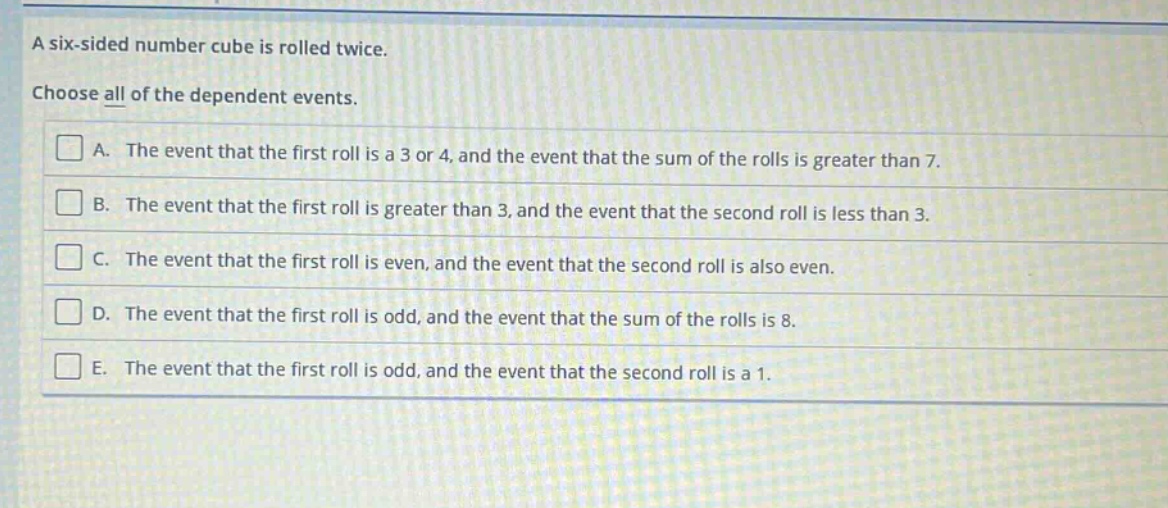
a six - sided number cube is rolled twice. choose all of the dependent events. a. the event that the first roll is a 3 or 4, and the event that the sum of the rolls is greater than 7. b. the event that the first roll is greater than 3, and the event that the second roll is less than 3. c. the event that the first roll is even, and the event that the second roll is also even. d. the event that the first roll is odd, and the event that the sum of the rolls is 8. e. the event that the first roll is odd, and the event that the second roll is a 1.
Answer
Answer:
A. The event that the first roll is a 3 or 4, and the event that the sum of the rolls is greater than 7. D. The event that the first roll is odd, and the event that the sum of the rolls is 8.
Explanation:
Step1: Define dependent events
Dependent events are events where the outcome of one affects the probability of the other.
Step2: Analyze option A
If first roll is 3 or 4, it impacts sum calculation. For example, if first - roll is 3, second - roll needs to be 5 or 6 for sum > 7. So, they are dependent.
Step3: Analyze option B
The first - roll result doesn't affect the second - roll result. Probability of second roll being less than 3 is always $\frac{2}{6}$ regardless of first roll. So, they are independent.
Step4: Analyze option C
The first - roll being even doesn't affect the second - roll being even. Probability of second roll being even is $\frac{3}{6}$ regardless of first roll. So, they are independent.
Step5: Analyze option D
If the first roll is odd (1, 3, 5), it affects the possible values of the second roll to get a sum of 8. For example, if first roll is 1, second roll must be 7 (not possible), if first roll is 3, second roll must be 5, if first roll is 5, second roll must be 3. So, they are dependent.
Step6: Analyze option E
The first - roll being odd doesn't affect the probability of the second roll being 1. Probability of second roll being 1 is $\frac{1}{6}$ regardless of first roll. So, they are independent.