a six - sided number cube is rolled twice. what is the probability that the first roll is an even number and…
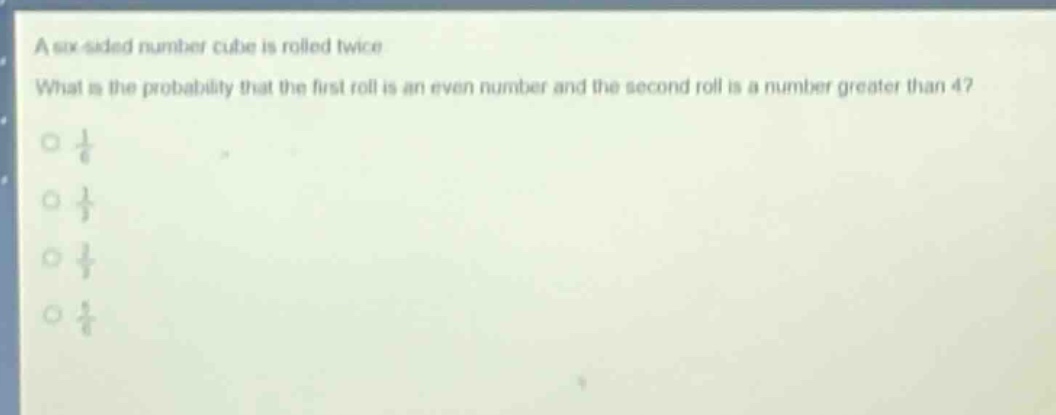
a six - sided number cube is rolled twice. what is the probability that the first roll is an even number and the second roll is a number greater than 4?
Answer
Explanation:
Step1: Find probability of first - roll being even
A six - sided die has 6 possible outcomes: 1, 2, 3, 4, 5, 6. The even numbers are 2, 4, 6. So the number of favorable outcomes for the first roll being even is 3. The probability $P(A)$ of the first roll being even is $P(A)=\frac{3}{6}=\frac{1}{2}$.
Step2: Find probability of second - roll being greater than 4
The numbers greater than 4 on a six - sided die are 5 and 6. So the number of favorable outcomes for the second roll being greater than 4 is 2. The probability $P(B)$ of the second roll being greater than 4 is $P(B)=\frac{2}{6}=\frac{1}{3}$.
Step3: Use the multiplication rule for independent events
Since the two rolls of the die are independent events, the probability that the first roll is an even number and the second roll is a number greater than 4 is $P(A\cap B)=P(A)\times P(B)$. Substitute $P(A)=\frac{1}{2}$ and $P(B)=\frac{1}{3}$ into the formula: $P(A\cap B)=\frac{1}{2}\times\frac{1}{3}=\frac{1}{6}$.
Answer:
$\frac{1}{6}$