no smoking: the general social survey conducted a poll of 679 adults in which the subjects were asked…
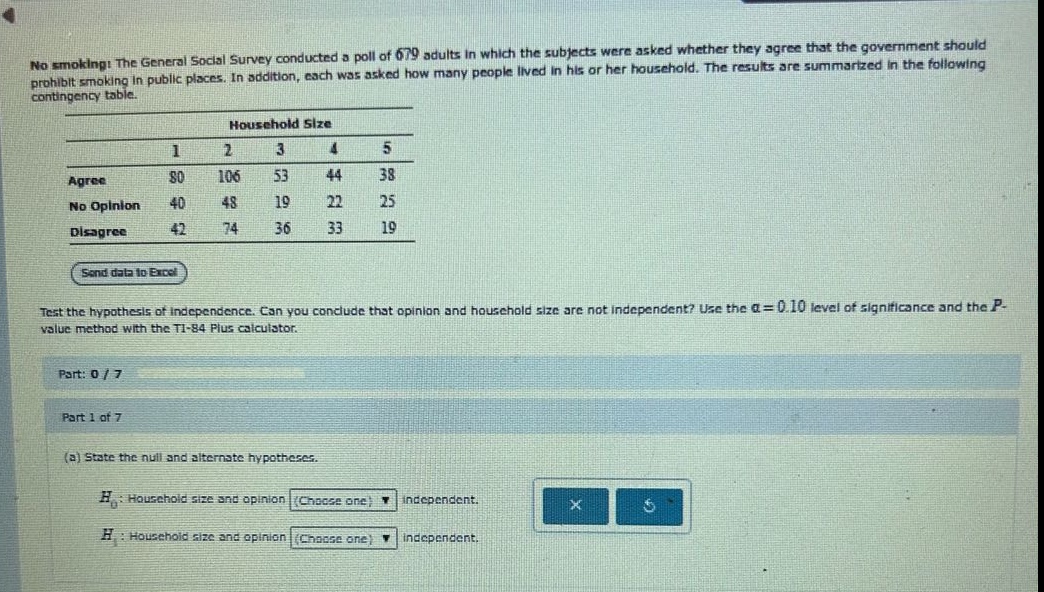
no smoking: the general social survey conducted a poll of 679 adults in which the subjects were asked whether they agree that the government should prohibit smoking in public places. in addition, each was asked how many people lived in his or her household. the results are summarized in the following contingency table.\n\n| household size | 1 | 2 | 3 | 4 | 5 |\n| ---- | ---- | ---- | ---- | ---- | ---- |\n| agree | 80 | 106 | 53 | 44 | 38 |\n| no opinion | 40 | 48 | 19 | 22 | 25 |\n| disagree | 42 | 74 | 36 | 33 | 19 |\n\nsend data to excel\n\ntest the hypothesis of independence. can you conclude that opinion and household size are not independent? use the \\(\\alpha = 0.10\\) level of significance and the p - value method with the ti - 84 plus calculator.\n\npart: 0 / 7\n\npart 1 of 7\n\n(a) state the null and alternate hypotheses.\n\n\\(h_0\\): household size and opinion choose one independent.\n\n\\(h_1\\): household size and opinion choose one independent.
Answer
Explanation:
Step1: Define null and alternative hypotheses
The null hypothesis ($H_0$) is that the two variables are independent. The alternative hypothesis ($H_1$) is that they are not independent. $H_0$: Household size and opinion are independent. $H_1$: Household size and opinion are not independent.
Answer:
$H_0$: Household size and opinion are independent. $H_1$: Household size and opinion are not independent.