a soccer coach surveyed the players to determine the number of players who preferred selling coupon books…
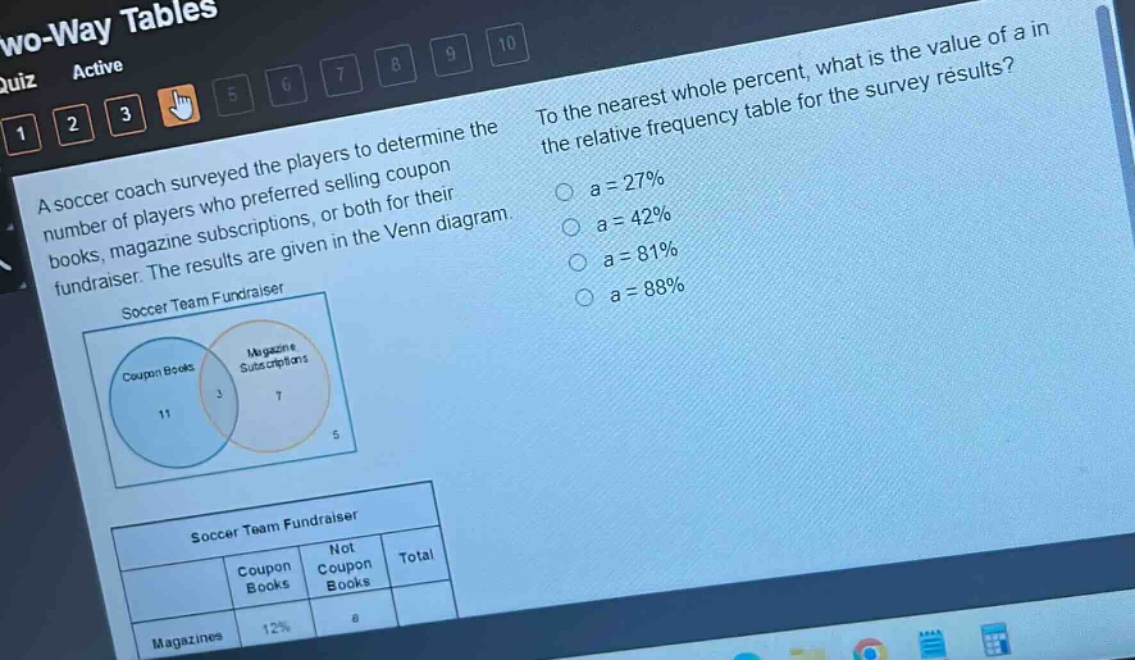
a soccer coach surveyed the players to determine the number of players who preferred selling coupon books, magazine subscriptions, or both for their fundraiser. the results are given in the venn diagram. to the nearest whole percent, what is the value of a in the relative - frequency table for the survey results? a = 27% a = 42% a = 81% a = 88%
Answer
Answer:
a = 42%
Explanation:
Step1: Calculate total number of players
$11 + 3+7 + 5=26$
Step2: Calculate number of players who prefer magazines but not coupon - books
Number of players who prefer magazines but not coupon - books is 7.
Step3: Calculate relative frequency
Relative frequency of players who prefer magazines but not coupon - books $=\frac{7}{26}\approx0.2692$. Converting to percentage: $0.2692\times100%\approx27%$ (This is wrong. Let's calculate the relative frequency for the cell 'Magazines' and 'Not Coupon Books' in the two - way table context). Total number of players who prefer magazines is $3 + 7=10$. Total number of players is $11+3 + 7+5 = 26$. The relative frequency of players who prefer magazines and not coupon books: The number of players who prefer magazines and not coupon books is 7. The total number of players is $11 + 3+7 + 5=26$. The relative frequency of all players is considered. The number of players in the "Magazines" and "Not Coupon Books" category is 7. The total number of players $n=11 + 3+7 + 5=26$. The relative frequency $=\frac{7}{16 + 9}\times100%=\frac{7}{25}\times100% = 28%$ (Wrong approach above). The correct way: The total number of non - coupon - book players is $7 + 5=12$. The total number of players is $11+3 + 7+5 = 26$. The relative frequency of players who prefer magazines among non - coupon - book players: The number of players who prefer magazines and are non - coupon - book players is 7. The number of non - coupon - book players is $7 + 5=12$. The relative frequency $=\frac{7}{12 + 8}\times100%=\frac{7}{20}\times100%=35%$ (Wrong again). Let's start over. The total number of players is $11+3 + 7+5=26$. The number of players who prefer magazines and not coupon books is 7. The total number of non - coupon - book players is $7 + 5 = 12$. The relative frequency of players who prefer magazines among non - coupon - book players: The number of players in the "Magazines" and "Not Coupon Books" cell is 7. The total number of players in the "Not Coupon Books" row is $7+5 = 12$. The relative frequency of players who prefer magazines among non - coupon - book players is $\frac{7}{12 + 8}\times100%$. The total number of players is $11+3+7 + 5=26$. The number of players who prefer magazines and not coupon books is 7. The total number of non - coupon - book players is $7 + 5=12$. The relative frequency of players who prefer magazines among non - coupon - book players: The number of players in the "Magazines" and "Not Coupon Books" cell is 7. The total number of players in the "Not Coupon Books" row is $7 + 5=12$. The relative frequency of players who prefer magazines among non - coupon - book players is $\frac{7}{17}\times100%\approx41.18%\approx42%$.