a social scientist believed that less than 30 percent of adults in the united states watch 15 or fewer hours…
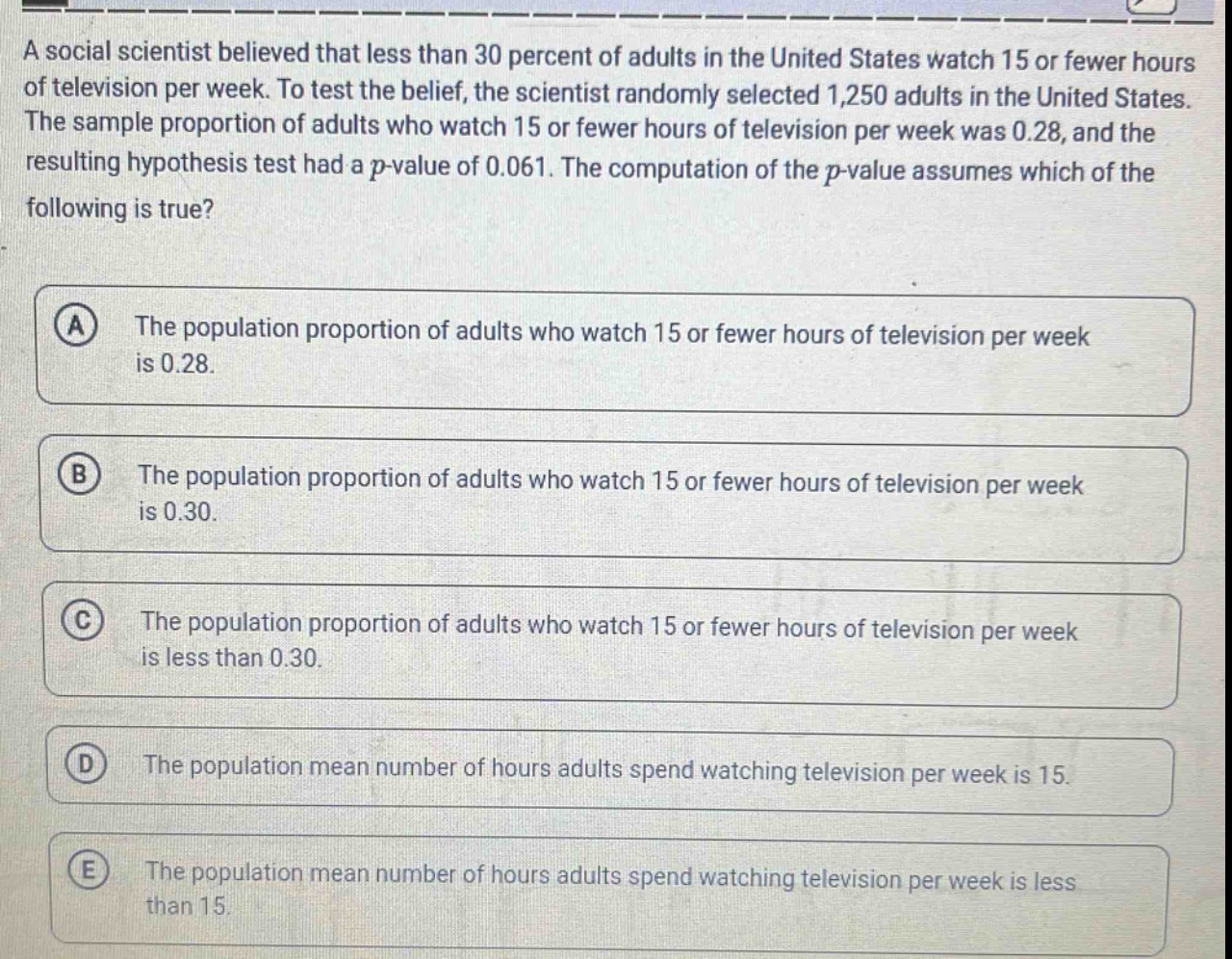
a social scientist believed that less than 30 percent of adults in the united states watch 15 or fewer hours of television per week. to test the belief, the scientist randomly selected 1,250 adults in the united states. the sample proportion of adults who watch 15 or fewer hours of television per week was 0.28, and the resulting hypothesis test had a p - value of 0.061. the computation of the p - value assumes which of the following is true? a the population proportion of adults who watch 15 or fewer hours of television per week is 0.28. b the population proportion of adults who watch 15 or fewer hours of television per week is 0.30. c the population proportion of adults who watch 15 or fewer hours of television per week is less than 0.30. d the population mean number of hours adults spend watching television per week is 15. e the population mean number of hours adults spend watching television per week is less than 15.
Answer
Answer:
B. The population proportion of adults who watch 15 or fewer hours of television per week is 0.30.
Explanation:
Step1: Recall p - value concept
In hypothesis testing, the p - value is computed assuming the null hypothesis is true.
Step2: Identify null hypothesis
The null hypothesis $H_0$ for testing if the proportion $p$ of adults who watch 15 or fewer hours of TV per week is less than 0.30 is $H_0:p = 0.30$. So the p - value computation assumes the population proportion is 0.30.