a social scientist collects information about study time for a random sample of 40 students with the…
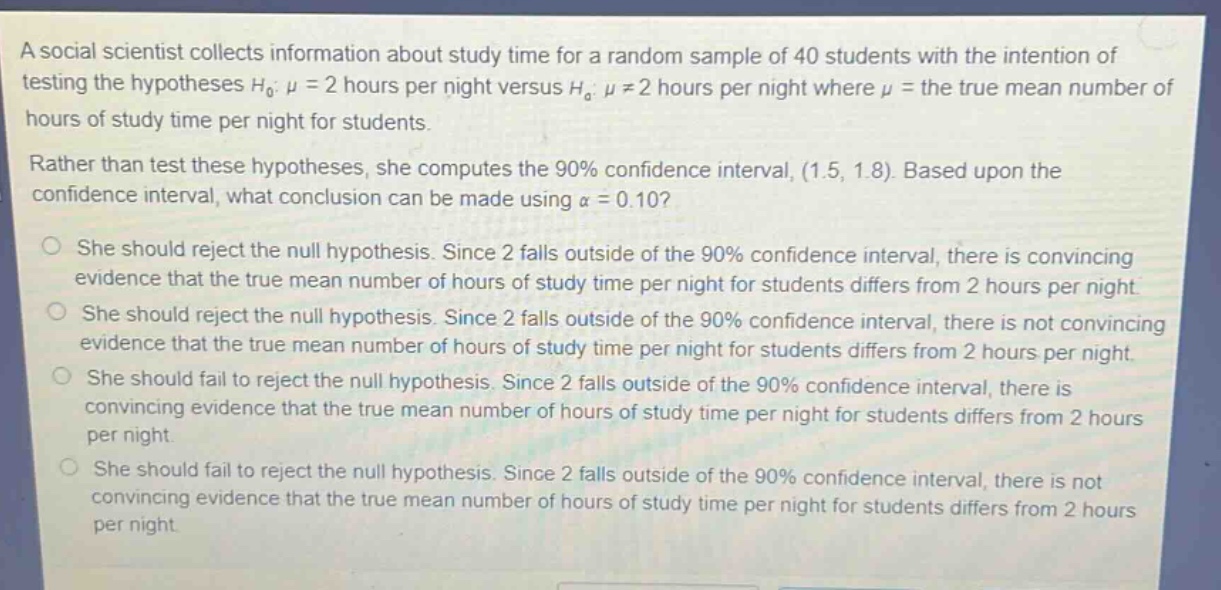
a social scientist collects information about study time for a random sample of 40 students with the intention of testing the hypotheses h0: μ = 2 hours per night versus ha: μ ≠ 2 hours per night where μ = the true mean number of hours of study time per night for students. rather than test these hypotheses, she computes the 90% confidence interval, (1.5, 1.8). based upon the confidence interval, what conclusion can be made using α = 0.10? she should reject the null hypothesis. since 2 falls outside of the 90% confidence interval, there is convincing evidence that the true mean number of hours of study time per night for students differs from 2 hours per night. she should reject the null hypothesis. since 2 falls outside of the 90% confidence interval, there is not convincing evidence that the true mean number of hours of study time per night for students differs from 2 hours per night. she should fail to reject the null hypothesis. since 2 falls outside of the 90% confidence interval, there is convincing evidence that the true mean number of hours of study time per night for students differs from 2 hours per night. she should fail to reject the null hypothesis. since 2 falls outside of the 90% confidence interval, there is not convincing evidence that the true mean number of hours of study time per night for students differs from 2 hours per night.
Answer
Brief Explanations:
In hypothesis - testing, if the hypothesized value of the population mean under the null hypothesis falls outside the confidence interval, we reject the null hypothesis. Here, the null hypothesis is $H_0:\mu = 2$ and the 90% confidence interval is (1.5, 1.8). Since 2 falls outside this interval, at a significance level of $\alpha=0.10$ (corresponding to a 90% confidence level), there is convincing evidence that the true mean differs from 2.
Answer:
She should reject the null hypothesis. Since 2 falls outside of the 90% confidence interval, there is convincing evidence that the true mean number of hours of study time per night for students differs from 2 hours per night.