social studies test - geography\nquestions 1 and 2 refer to the following population data.\npopulation on…
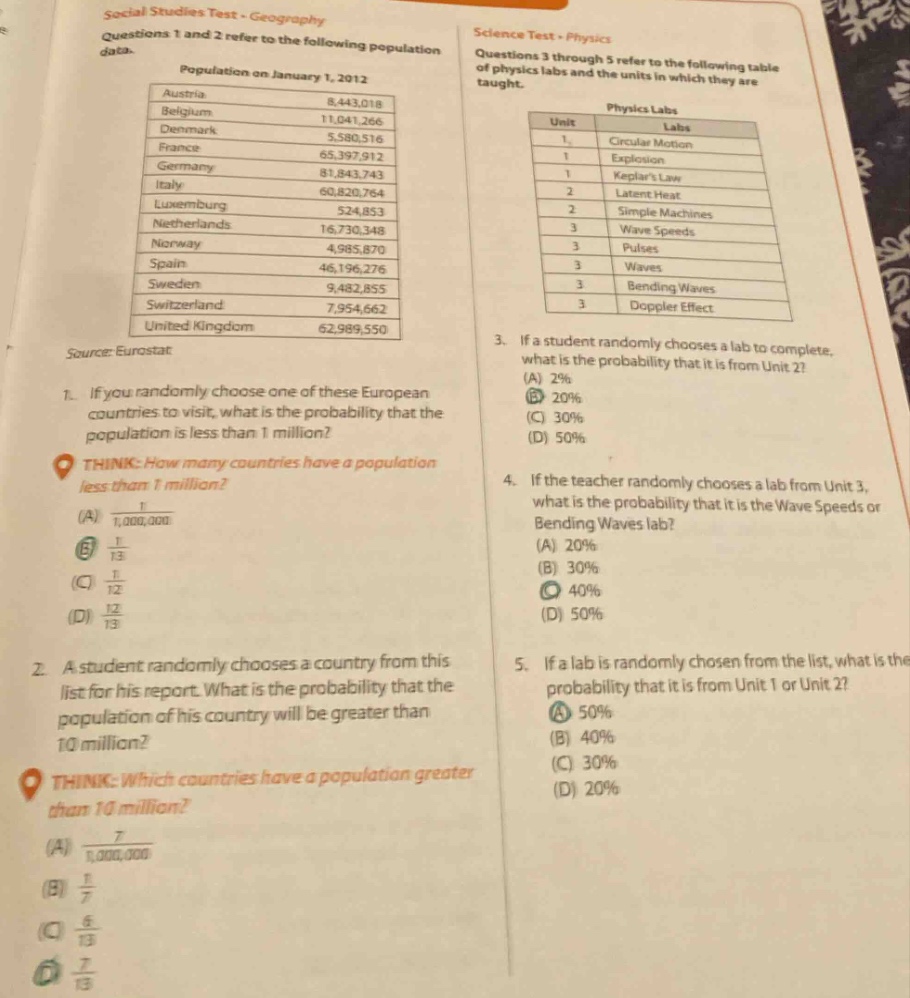
social studies test - geography\nquestions 1 and 2 refer to the following population data.\npopulation on january 1, 2012\naustria 8,443,018\nbelgium 11,041,266\ndenmark 5,580,516\nfrance 65,397,912\ngermany 81,843,743\nitaly 60,820,764\nluxemburg 524,853\nnetherlands 16,730,348\nnorway 4,985,870\nspain 46,196,276\nsweden 9,482,855\nswitzerland 7,954,662\nunited kingdom 62,989,550\nsource: eurostat\n1. if you randomly choose one of these european countries to visit, what is the probability that the population is less than 1 million?\nthink: how many countries have a population less than 1 million?\n(a) 1/1,000,000\n(b) 1/13\n(c) 1/12\n(d) 12/13\n2. a student randomly chooses a country from this list for his report. what is the probability that the population of his country will be greater than 10 million?\nthink: which countries have a population greater than 10 million?\n(a) 1/1,000,000\n(b) 1/7\n(c) 6/13\n(d) 7/13\nscience test - physics\nquestions 3 through 5 refer to the following table of physics labs and the units in which they are taught.\nphysics labs\nunits labs\n1 circular motion\n1 explosion\n1 keplers law\n2 latent heat\n2 simple machines\n3 wave speeds\n3 pulses\n3 waves\n3 bending waves\n3 doppler effect\n3. if a student randomly chooses a lab to complete, what is the probability that it is from unit 2?\n(a) 2%\n(b) 20%\n(c) 30%\n(d) 50%\n4. if the teacher randomly chooses a lab from unit 3, what is the probability that it is the wave speeds or bending waves lab?\n(a) 20%\n(b) 30%\n(c) 40%\n(d) 50%\n5. if a lab is randomly chosen from the list, what is the probability that it is from unit 1 or unit 2?\n(a) 50%\n(b) 40%\n(c) 30%\n(d) 20%
Answer
Explanation:
Step1: Count total number of countries
There are 13 countries in the population - data table.
Step2: Count countries with population less than 1 million
Luxembourg has a population less than 1 million. So there is 1 such country.
Step3: Calculate probability for question 1
The probability $P_1$ of choosing a country with population less than 1 million is $P_1=\frac{\text{Number of favorable outcomes}}{\text{Total number of outcomes}}=\frac{1}{13}$.
Step4: Count countries with population greater than 10 million
Austria (8,443,018 - no), Belgium (11,041,266 - yes), Denmark (5,580,516 - no), France (65,397,912 - yes), Germany (81,843,743 - yes), Italy (60,820,764 - yes), Luxembourg (524,853 - no), Netherlands (16,730,348 - yes), Norway (4,985,870 - no), Spain (46,196,276 - yes), Sweden (9,482,855 - no), Switzerland (7,954,662 - no), United - Kingdom (62,989,550 - yes). There are 7 countries with population greater than 10 million.
Step5: Calculate probability for question 2
The probability $P_2$ of choosing a country with population greater than 10 million is $P_2 = \frac{7}{13}$.
Step6: Count total number of labs
Counting all the labs in the physics - labs table, there are 10 labs.
Step7: Count labs from Unit 2
There are 2 labs from Unit 2. The probability $P_3$ of choosing a lab from Unit 2 is $P_3=\frac{2}{10}=0.2 = 20%$.
Step8: Count labs in Unit 3
There are 5 labs in Unit 3.
Step9: Count Wave Speeds or Bending Waves labs in Unit 3
There are 2 such labs in Unit 3. The probability $P_4$ of choosing Wave Speeds or Bending Waves lab from Unit 3 is $P_4=\frac{2}{5}=0.4 = 40%$.
Step10: Count labs from Unit 1 or Unit 2
There are 3 labs from Unit 1 and 2 labs from Unit 2. So there are $3 + 2=5$ labs from Unit 1 or Unit 2. The probability $P_5$ of choosing a lab from Unit 1 or Unit 2 is $P_5=\frac{5}{10}=0.5 = 50%$.
Answer:
- B. $\frac{1}{13}$
- D. $\frac{7}{13}$
- B. 20%
- C. 40%
- A. 50%