a spinner has 10 equally sized sections, 4 of which are gray and 6 of which are blue. the spinner is spun…
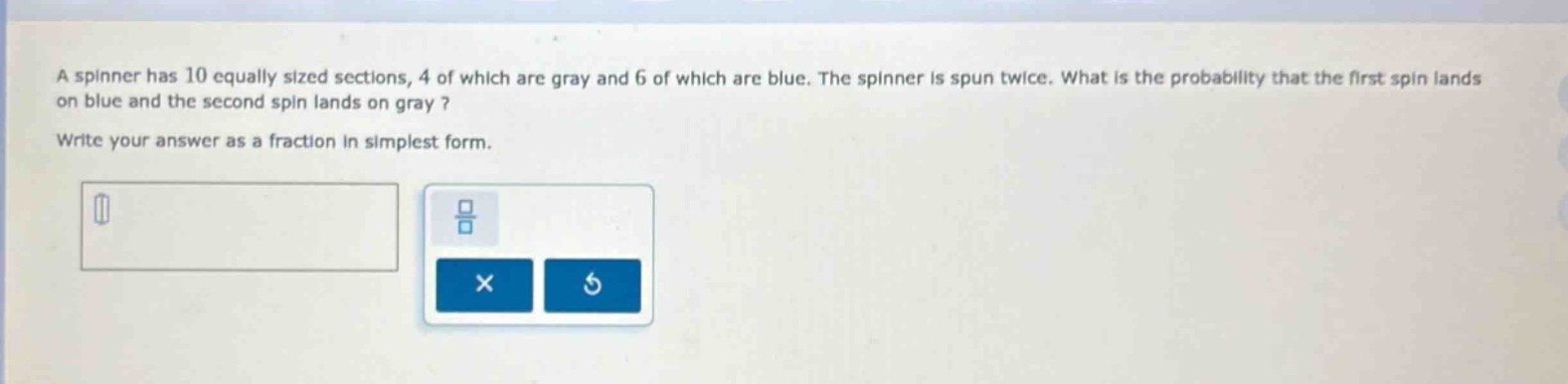
a spinner has 10 equally sized sections, 4 of which are gray and 6 of which are blue. the spinner is spun twice. what is the probability that the first spin lands on blue and the second spin lands on gray? write your answer as a fraction in simplest form.
Answer
Explanation:
Step1: Calculate probability of first - spin being blue
The probability of an event is the number of favorable outcomes divided by the total number of outcomes. There are 6 blue sections out of 10 total sections. So the probability of the first spin landing on blue, $P(B_1)=\frac{6}{10}=\frac{3}{5}$.
Step2: Calculate probability of second - spin being gray
Since the spins are independent events, after the first spin, the situation for the second spin is the same as the first in terms of probabilities. There are 4 gray sections out of 10 total sections. So the probability of the second spin landing on gray, $P(G_2)=\frac{4}{10}=\frac{2}{5}$.
Step3: Calculate the joint probability
For two independent events $A$ and $B$, the probability of both $A$ and $B$ occurring is $P(A)\times P(B)$. Here, the probability that the first spin lands on blue and the second spin lands on gray is $P = P(B_1)\times P(G_2)$. Substitute the values: $P=\frac{3}{5}\times\frac{2}{5}=\frac{6}{25}$.
Answer:
$\frac{6}{25}$