the spinner is equally likely to land on any of the six sections. what is the probability that the spinner…
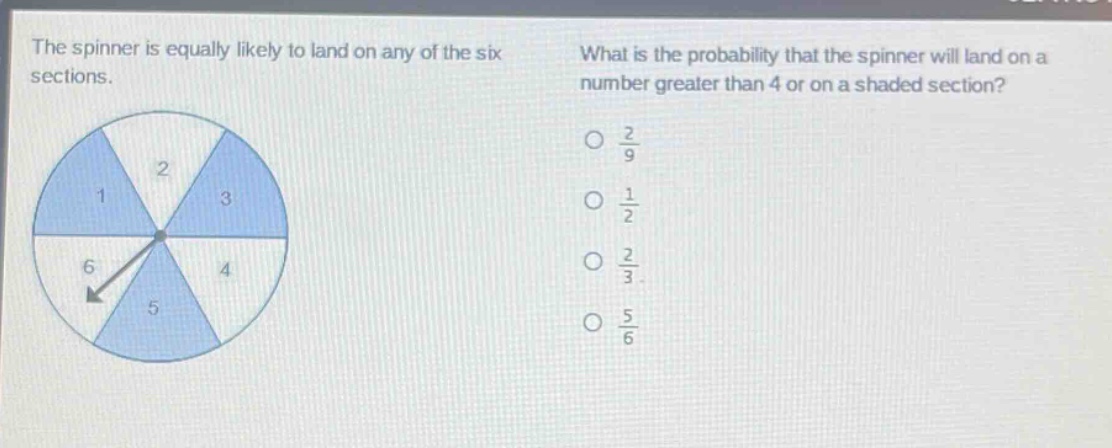
the spinner is equally likely to land on any of the six sections. what is the probability that the spinner will land on a number greater than 4 or on a shaded section? \no $\frac{2}{9}$\no $\frac{1}{2}$\no $\frac{2}{3}$\no $\frac{5}{6}$
Answer
Explanation:
Step1: Define events
Let $A$ be the event that the spinner lands on a number greater than 4. So $A={5,6}$. Let $B$ be the event that the spinner lands on a shaded - section. So $B = {1,3,5}$.
Step2: Calculate probabilities of individual events
The probability of an event $E$ in a sample - space $S$ with $n(S)$ equally - likely outcomes and $n(E)$ favorable outcomes is given by $P(E)=\frac{n(E)}{n(S)}$. Here, $n(S) = 6$. $P(A)=\frac{2}{6}$ since $n(A)=2$. $P(B)=\frac{3}{6}$ since $n(B)=3$.
Step3: Calculate the intersection of events
$A\cap B={5}$, so $P(A\cap B)=\frac{1}{6}$ since $n(A\cap B)=1$.
Step4: Use the addition rule of probability
The addition rule of probability for two events $A$ and $B$ is $P(A\cup B)=P(A)+P(B)-P(A\cap B)$. $P(A\cup B)=\frac{2}{6}+\frac{3}{6}-\frac{1}{6}=\frac{2 + 3-1}{6}=\frac{4}{6}=\frac{2}{3}$.
Answer:
$\frac{2}{3}$