the spinner is equally likely to land on any of the six sections. what is the probability that the spinner…
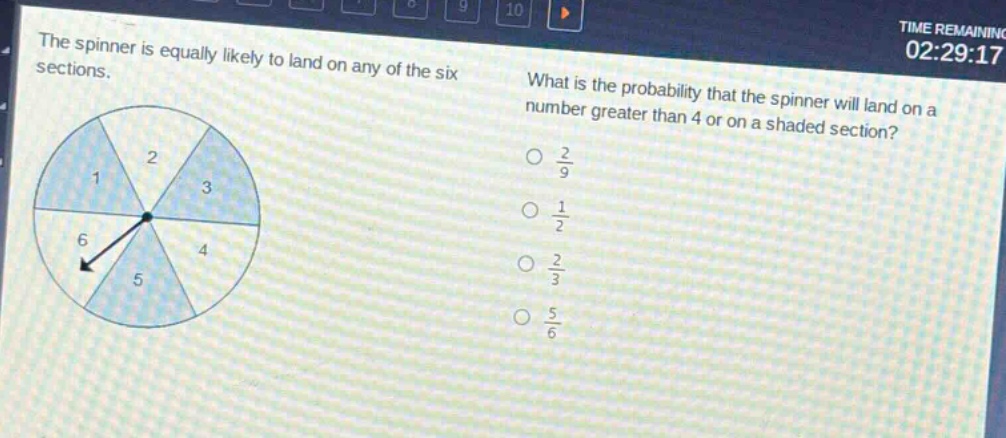
the spinner is equally likely to land on any of the six sections. what is the probability that the spinner will land on a number greater than 4 or on a shaded section? o $\frac{2}{9}$ o $\frac{1}{2}$ o $\frac{2}{3}$ o $\frac{5}{6}$
Answer
Explanation:
Step1: Identify the total possible outcomes.
The spinner has 6 equally likely sections numbered 1 to 6. $$ \text{Total outcomes} = {1, 2, 3, 4, 5, 6} $$ The total number of outcomes is $N = 6$.
Step2: Identify outcomes for landing on a number greater than 4.
Let A be the event that the spinner lands on a number greater than 4. $$ A = {5, 6} $$ The number of outcomes in A is $n(A) = 2$.
Step3: Identify outcomes for landing on a shaded section.
Let B be the event that the spinner lands on a shaded section. From the image, the shaded sections are 1, 3, and 5. $$ B = {1, 3, 5} $$ The number of outcomes in B is $n(B) = 3$.
Step4: Identify outcomes for landing on a number greater than 4 OR a shaded section.
We need the union of events A and B, denoted by $A \cup B$. This includes outcomes that are in A, or in B, or in both. $$ A \cup B = {1, 3, 5, 6} $$ The number of outcomes in $A \cup B$ is $n(A \cup B) = 4$.
Step5: Calculate the probability.
The probability of an event is the ratio of the number of favorable outcomes to the total number of outcomes. $$ P(A \cup B) = \frac{n(A \cup B)}{N} $$ $$ P(A \cup B) = \frac{4}{6} $$ $$ P(A \cup B) = \frac{2}{3} $$
Answer:
C. $\frac{2}{3}$