a spinner has five congruent sections, one each of blue, green, red, orange, and yellow. yuri spins the…
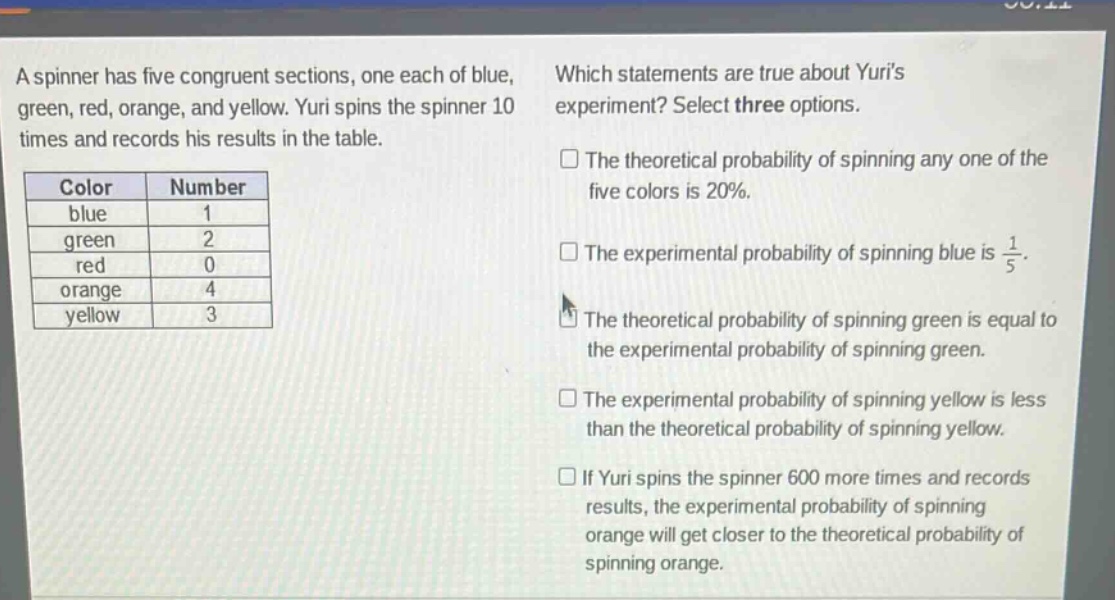
a spinner has five congruent sections, one each of blue, green, red, orange, and yellow. yuri spins the spinner 10 times and records his results in the table.\n| color | number |\n| blue | 1 |\n| green | 2 |\n| red | 0 |\n| orange | 4 |\n| yellow | 3 |\nwhich statements are true about yuris experiment? select three options.\nthe theoretical probability of spinning any one of the five colors is 20%.\nthe experimental probability of spinning blue is $\frac{1}{5}$.\nthe theoretical probability of spinning green is equal to the experimental probability of spinning green.\nthe experimental probability of spinning yellow is less than the theoretical probability of spinning yellow.\nif yuri spins the spinner 600 more times and records results, the experimental probability of spinning orange will get closer to the theoretical probability of spinning orange.
Answer
Explanation:
Step1: Calculate theoretical probability
Since there are 5 congruent sections, the theoretical probability of spinning any one color is $\frac{1}{5}=0.2 = 20%$.
Step2: Calculate experimental probabilities
The experimental probability of spinning blue is $\frac{1}{10}$, of green is $\frac{2}{10}=\frac{1}{5}$, of red is $\frac{0}{10} = 0$, of orange is $\frac{4}{10}=\frac{2}{5}$, and of yellow is $\frac{3}{10}$.
Step3: Analyze each statement
- The theoretical probability of spinning any one of the five colors is indeed $20%$ (or $\frac{1}{5}$), so the first statement is true.
- The experimental probability of spinning blue is $\frac{1}{10}$, not $\frac{1}{5}$, so the second statement is false.
- The theoretical probability of spinning green is $\frac{1}{5}$ and the experimental probability of spinning green is $\frac{2}{10}=\frac{1}{5}$, so the third statement is true.
- The theoretical probability of spinning yellow is $\frac{1}{5}=0.2$ and the experimental probability of spinning yellow is $\frac{3}{10} = 0.3$, so the experimental probability of spinning yellow is greater than the theoretical probability, and the fourth statement is false.
- According to the law of large - numbers, as the number of trials increases, the experimental probability gets closer to the theoretical probability. So if Yuri spins the spinner 600 more times, the experimental probability of spinning orange will get closer to the theoretical probability of $\frac{1}{5}$, and the fifth statement is true.
Answer:
The theoretical probability of spinning any one of the five colors is 20%. The theoretical probability of spinning green is equal to the experimental probability of spinning green. If Yuri spins the spinner 600 more times and records results, the experimental probability of spinning orange will get closer to the theoretical probability of spinning orange.