a spinner with repeated colors numbered from 1 to 8 is shown. sections 1 and 8 are purple. sections 2 and 3…
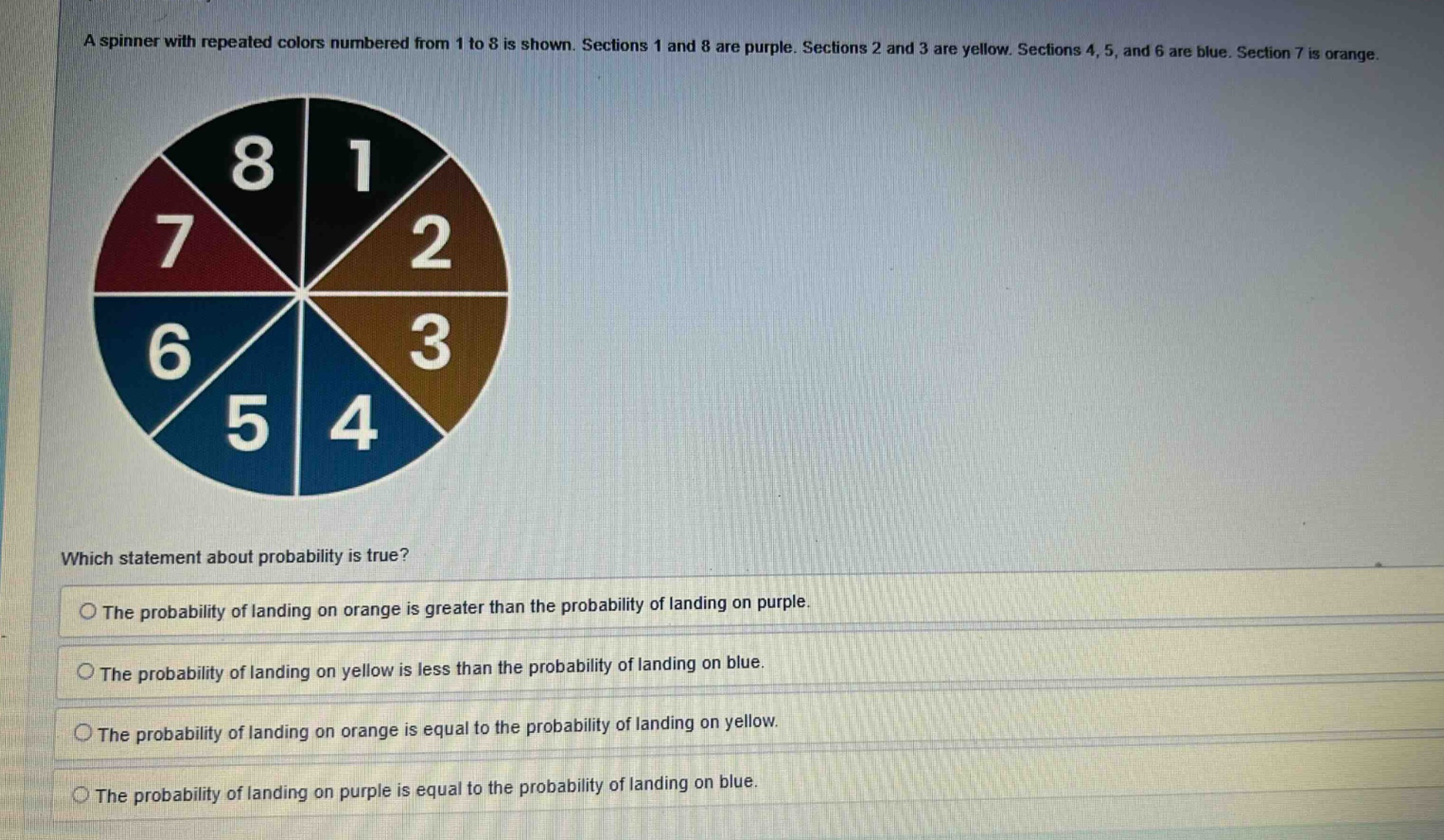
a spinner with repeated colors numbered from 1 to 8 is shown. sections 1 and 8 are purple. sections 2 and 3 are yellow. sections 4, 5, and 6 are blue. section 7 is orange. which statement about probability is true? the probability of landing on orange is greater than the probability of landing on purple. the probability of landing on yellow is less than the probability of landing on blue. the probability of landing on orange is equal to the probability of landing on yellow. the probability of landing on purple is equal to the probability of landing on blue.
Answer
Explanation:
Step1: Calculate total sections
The spinner has 8 sections, so the total number of possible outcomes is 8.
Step2: Calculate probability of each color
- Purple: Sections 1 and 8 are purple, so $P(\text{purple})=\frac{2}{8}=\frac{1}{4}$.
- Yellow: Sections 2 and 3 are yellow, so $P(\text{yellow})=\frac{2}{8}=\frac{1}{4}$.
- Blue: Sections 4, 5, and 6 are blue, so $P(\text{blue})=\frac{3}{8}$.
- Orange: Section 7 is orange, so $P(\text{orange})=\frac{1}{8}$.
Step3: Compare probabilities
- Compare orange and purple: $\frac{1}{8}<\frac{1}{4}$, so probability of orange is less than purple.
- Compare yellow and blue: $\frac{1}{4}<\frac{3}{8}$, so probability of yellow is less than blue.
- Compare orange and yellow: $\frac{1}{8}\neq\frac{1}{4}$, so they are not equal.
- Compare purple and blue: $\frac{1}{4}\neq\frac{3}{8}$, so they are not equal.
Answer:
The probability of landing on yellow is less than the probability of landing on blue.