the spinner shown has eight equal-sized sections. the pointer lands on an even number 135 times out of 250…
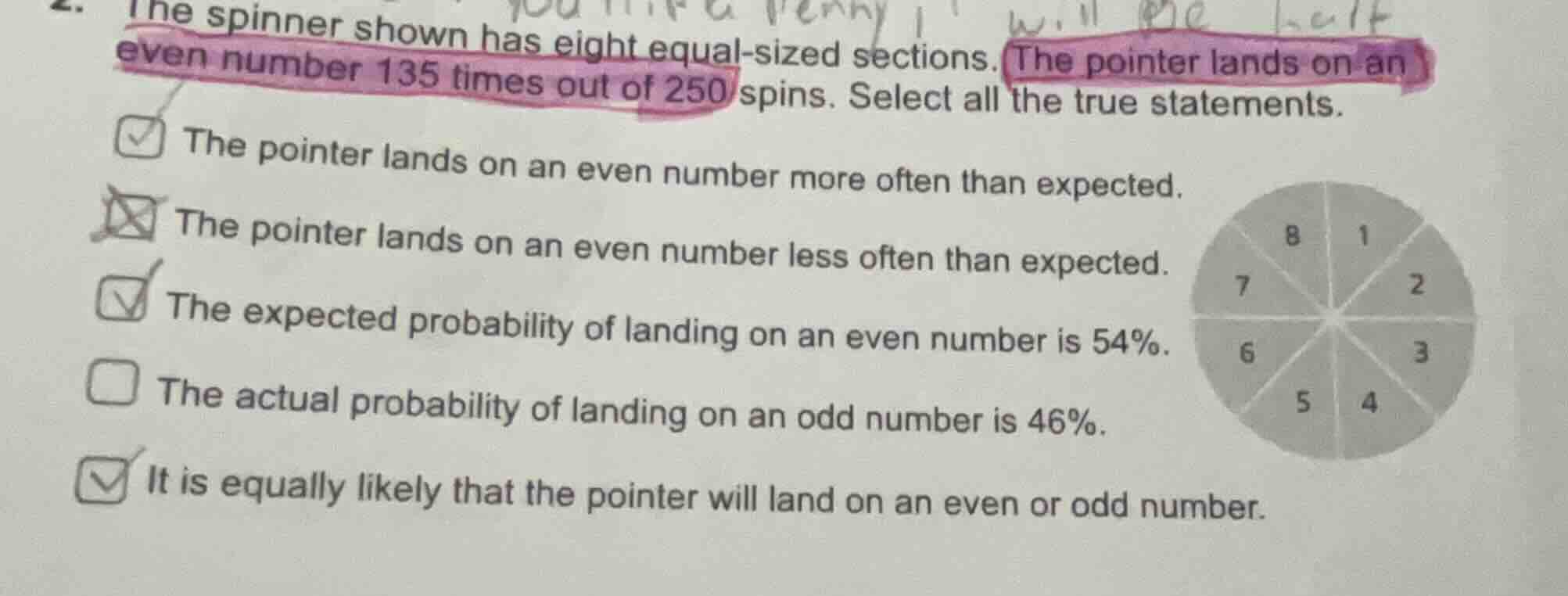
the spinner shown has eight equal-sized sections. the pointer lands on an even number 135 times out of 250 spins. select all the true statements.\n\n- the pointer lands on an even number more often than expected.\n- the pointer lands on an even number less often than expected.\n- the expected probability of landing on an even number is $54\\%$.\n- the actual probability of landing on an odd number is $46\\%$.\n- it is equally likely that the pointer will land on an even or odd number.
Answer
Explanation:
Step1: Calculate theoretical probability of even numbers
The spinner has 8 equal sections (1-8). Even numbers are ${2, 4, 6, 8}$. $$P(\text{even}) = \frac{4}{8} = 0.5 = 50%$$
Step2: Calculate expected frequency for 250 spins
Multiply the total spins by the theoretical probability. $$E = 250 \times 0.5 = 125$$
Step3: Compare actual frequency to expected frequency
The actual frequency is 135. Since $135 > 125$, it landed on even more often than expected.
Step4: Calculate actual probability of odd numbers
Actual even results = 135. Actual odd results = $250 - 135 = 115$. $$P(\text{actual odd}) = \frac{115}{250} = 0.46 = 46%$$
Step5: Evaluate "equally likely" statement
Theoretical probability for even and odd is $50%$ each, making them equally likely. $$P(\text{even}) = P(\text{odd}) = 0.5$$
Answer:
The pointer lands on an even number more often than expected. The actual probability of landing on an odd number is 46%. It is equally likely that the pointer will land on an even or odd number.