a spinner has three equal sections labeled 1, 2, and 3. it is spun twice. which expression can be used to…
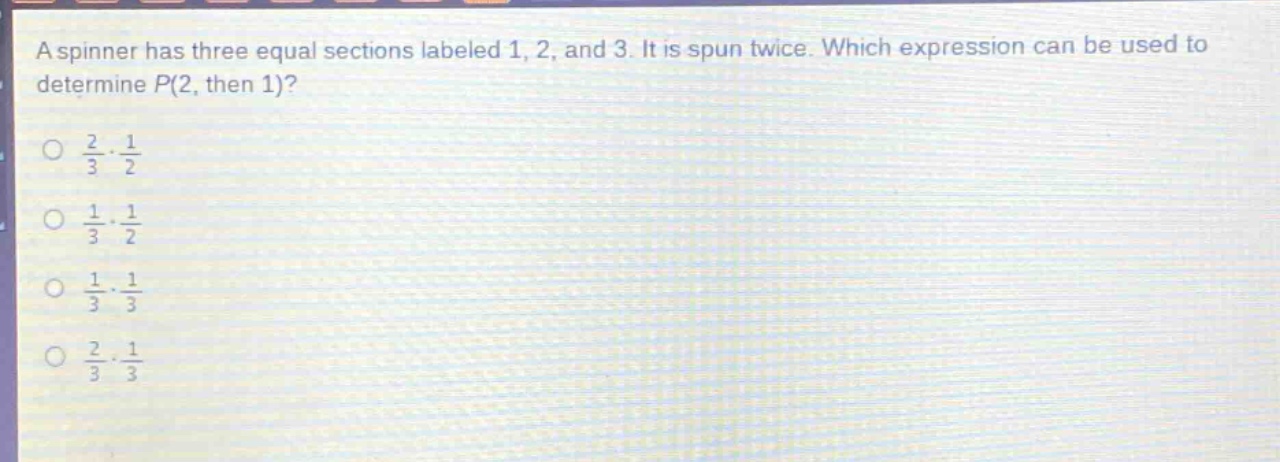
a spinner has three equal sections labeled 1, 2, and 3. it is spun twice. which expression can be used to determine p(2, then 1)?\no $\frac{2}{3}cdot\frac{1}{2}$\no $\frac{1}{3}cdot\frac{1}{2}$\no $\frac{1}{3}cdot\frac{1}{3}$\no $\frac{2}{3}cdot\frac{1}{3}$
Answer
Explanation:
Step1: Calculate probability of getting 2 on first spin
The spinner has 3 equal - sections. The probability of getting a 2 on the first spin is $\frac{1}{3}$ since there is 1 section labeled 2 out of 3 total sections.
Step2: Calculate probability of getting 1 on second spin
The spins are independent events. After the first spin, the probability of getting a 1 on the second spin is also $\frac{1}{3}$ since there is 1 section labeled 1 out of 3 total sections.
Step3: Use multiplication rule for independent events
For independent events $A$ and $B$, $P(A\text{ and }B)=P(A)\times P(B)$. Here, $A$ is the event of getting 2 on the first spin and $B$ is the event of getting 1 on the second spin. So $P(2,\text{ then }1)=\frac{1}{3}\times\frac{1}{3}$.
Answer:
$\frac{1}{3}\cdot\frac{1}{3}$ (corresponding to the third option)