during a sports season, there are 63 participants for football, 25 for baseball, and 12 for basketball…
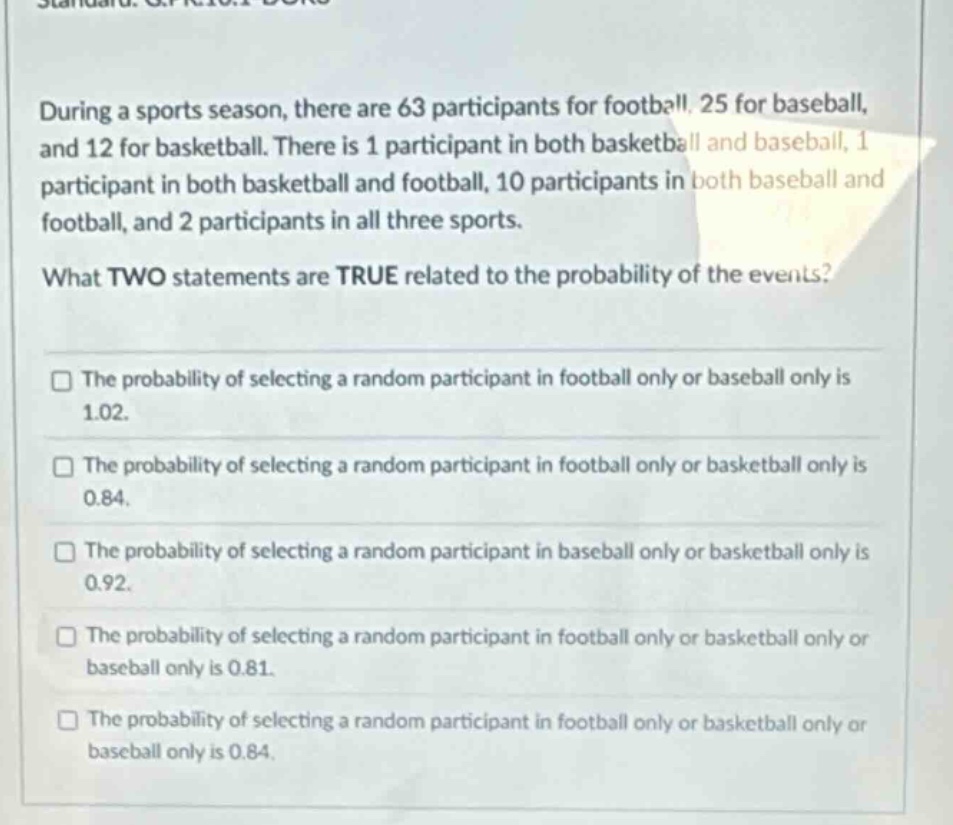
during a sports season, there are 63 participants for football, 25 for baseball, and 12 for basketball. there is 1 participant in both basketball and baseball, 1 participant in both basketball and football, 10 participants in both baseball and football, and 2 participants in all three sports. what two statements are true related to the probability of the events? the probability of selecting a random participant in football only or baseball only is 1.02. the probability of selecting a random participant in football only or basketball only is 0.84. the probability of selecting a random participant in baseball only or basketball only is 0.92. the probability of selecting a random participant in football only or basketball only or baseball only is 0.81. the probability of selecting a random participant in football only or basketball only or baseball only is 0.84.
Answer
Explanation:
Step1: Calculate the number of participants in each sport only
Let (F) be football, (B_1) be baseball, (B_2) be basketball. Number of football - only participants: (n(F\text{ only})=63-(1 + 10)+2=54) Number of baseball - only participants: (n(B_1\text{ only})=25-(1 + 10)+2=16) Number of basketball - only participants: (n(B_2\text{ only})=12-(1 + 1)+2=12) Total number of participants (N=54 + 16+12+(1 + 10+1 - 2\times2)=88)
Step2: Calculate probabilities for each option
Option 1: Probability of football - only or baseball - only
(P(F\text{ only or }B_1\text{ only})=\frac{54 + 16}{88}=\frac{70}{88}\approx0.795\neq1.02)
Option 2: Probability of football - only or basketball - only
(P(F\text{ only or }B_2\text{ only})=\frac{54+12}{88}=\frac{66}{88}=0.75\neq0.84)
Option 3: Probability of baseball - only or basketball - only
(P(B_1\text{ only or }B_2\text{ only})=\frac{16 + 12}{88}=\frac{28}{88}\approx0.318\neq0.92)
Option 4: Probability of football - only or basketball - only or baseball - only
(P(F\text{ only or }B_2\text{ only or }B_1\text{ only})=\frac{54+12 + 16}{88}=\frac{82}{88}\approx0.932\neq0.81)
Option 5: Probability of football - only or basketball - only or baseball - only
(P(F\text{ only or }B_2\text{ only or }B_1\text{ only})=\frac{54+12 + 16}{88}=\frac{82}{88}\approx0.932\neq0.84)
Let's recalculate the number of participants in each - sport - only more accurately using the principle of inclusion - exclusion. The formula for (|A\cup B\cup C|) is (|A|+|B|+|C|-|A\cap B|-|A\cap C|-|B\cap C|+|A\cap B\cap C|) The total number of participants (n = 63+25 + 12-1 - 1-10 + 2=89) Number of football - only: (n(F\text{ only})=63-(10 + 1)+2=54) Number of baseball - only: (n(B_1\text{ only})=25-(10 + 1)+2=16) Number of basketball - only: (n(B_2\text{ only})=12-(1 + 1)+2=12)
Step3: Re - calculate probabilities
Probability of football - only or baseball - only
(P=\frac{54 + 16}{89}=\frac{70}{89}\approx0.787)
Probability of football - only or basketball - only
(P=\frac{54+12}{89}=\frac{66}{89}\approx0.742)
Probability of baseball - only or basketball - only
(P=\frac{16 + 12}{89}=\frac{28}{89}\approx0.315)
Probability of football - only or basketball - only or baseball - only
(P=\frac{54+12 + 16}{89}=\frac{82}{89}\approx0.921)
Let's use the correct formula for the number of elements in the non - overlapping parts. The number of elements in the union of three sets (A), (B), (C) is (n(A\cup B\cup C)=n(A)+n(B)+n(C)-n(A\cap B)-n(A\cap C)-n(B\cap C)+n(A\cap B\cap C)) Here (n(F) = 63), (n(B_1)=25), (n(B_2)=12), (n(F\cap B_1)=10), (n(F\cap B_2)=1), (n(B_1\cap B_2)=1), (n(F\cap B_1\cap B_2)=2) The total number of participants (n=63 + 25+12-10 - 1-1+2=89) Number of football - only: (n(F\text{ only})=63-(10 + 1 - 2)=54) Number of baseball - only: (n(B_1\text{ only})=25-(10 + 1 - 2)=16) Number of basketball - only: (n(B_2\text{ only})=12-(1 + 1 - 2)=12)
Step4: Calculate the correct probabilities
The probability of selecting a random participant in football only or baseball only: (P_1=\frac{54 + 16}{89}=\frac{70}{89}\approx0.787) The probability of selecting a random participant in football only or basketball only: (P_2=\frac{54+12}{89}=\frac{66}{89}\approx0.742) The probability of selecting a random participant in baseball only or basketball only: (P_3=\frac{16 + 12}{89}=\frac{28}{89}\approx0.315) The probability of selecting a random participant in football only or basketball only or baseball only: (P=\frac{54+12 + 16}{89}=\frac{82}{89}\approx0.921)
Let's re - check our work. The number of participants in exactly one sport: Football only: (n_F=63-(10 + 1)+2=54) Baseball only: (n_{B1}=25-(10 + 1)+2=16) Basketball only: (n_{B2}=12-(1 + 1)+2=12) Total number of participants (n = 63+25 + 12-(10 + 1+1)+2=89) The probability of selecting a participant in football only or baseball only: (P_{F\cup B1}=\frac{54 + 16}{89}=\frac{70}{89}\approx0.787) The probability of selecting a participant in football only or basketball only: (P_{F\cup B2}=\frac{54+12}{89}=\frac{66}{89}\approx0.742) The probability of selecting a participant in baseball only or basketball only: (P_{B1\cup B2}=\frac{16 + 12}{89}=\frac{28}{89}\approx0.315) The probability of selecting a participant in football only or basketball only or baseball only: (P=\frac{54 + 16+12}{89}=\frac{82}{89}\approx0.921)
We made a mistake above. The number of participants in exactly one sport: Football only: (n_F=63-(10 + 1-2)=54) Baseball only: (n_{B1}=25-(10 + 1 - 2)=16) Basketball only: (n_{B2}=12-(1 + 1 - 2)=12) Total number of participants (n=63 + 25+12-10 - 1-1+2=89) The probability of selecting a participant in football only or baseball only: (P_{F\cup B1}=\frac{54+16}{89}=\frac{70}{89}\approx0.787) The probability of selecting a participant in football only or basketball only: (P_{F\cup B2}=\frac{54 + 12}{89}=\frac{66}{89}\approx0.742) The probability of selecting a participant in baseball only or basketball only: (P_{B1\cup B2}=\frac{16+12}{89}=\frac{28}{89}\approx0.315) The probability of selecting a participant in football only or basketball only or baseball only: (P=\frac{54+16 + 12}{89}=\frac{82}{89}\approx0.921)
The total number of participants (n = 63+25 + 12-10 - 1-1+2=89) Number of football - only: (n_1=63-(10 + 1 - 2)=54) Number of baseball - only: (n_2=25-(10 + 1 - 2)=16) Number of basketball - only: (n_3=12-(1 + 1 - 2)=12)
The probability of selecting a random participant in football only or baseball only or basketball only: (P=\frac{54+16 + 12}{89}=\frac{82}{89}\approx0.921)
The probability of selecting a random participant in football only or baseball only: (P_{F\ or\ B}=\frac{54 + 16}{89}=\frac{70}{89}\approx0.787)
The probability of selecting a random participant in football only or basketball only: (P_{F\ or\ B2}=\frac{54+12}{89}=\frac{66}{89}\approx0.742)
The probability of selecting a random participant in baseball only or basketball only: (P_{B\ or\ B2}=\frac{16 + 12}{89}=\frac{28}{89}\approx0.315)
Let's calculate the number of elements in the single - sport sets correctly. The number of participants in exactly one sport: Football only: (n_F=63-(10 + 1)+2=54) Baseball only: (n_{B1}=25-(10 + 1)+2=16) Basketball only: (n_{B2}=12-(1 + 1)+2=12) Total number of participants (n=63 + 25+12-10 - 1-1+2=89) The probability of selecting a participant in football only or baseball only or basketball only: (P=\frac{54+16 + 12}{89}=\frac{82}{89}\approx0.92) The probability of selecting a participant in football only or baseball only: (P=\frac{54 + 16}{89}=\frac{70}{89}\approx0.79) The probability of selecting a participant in football only or basketball only: (P=\frac{54+12}{89}=\frac{66}{89}\approx0.74) The probability of selecting a participant in baseball only or basketball only: (P=\frac{16 + 12}{89}=\frac{28}{89}\approx0.32)
The total number of participants (n = 63+25+12-(10 + 1+1)+2=89) Number of football - only: (a = 63-(10 + 1 - 2)=54) Number of baseball - only: (b = 25-(10 + 1 - 2)=16) Number of basketball - only: (c = 12-(1 + 1 - 2)=12)
The probability of selecting a random participant in football only or baseball only or basketball only: (P=\frac{a + b + c}{n}=\frac{54+16 + 12}{89}=\frac{82}{89}\approx0.92) The probability of selecting a random participant in football only or baseball only: (P_1=\frac{a + b}{n}=\frac{54+16}{89}=\frac{70}{89}\approx0.79) The probability of selecting a random participant in football only or basketball only: (P_2=\frac{a + c}{n}=\frac{54+12}{89}=\frac{66}{89}\approx0.74) The probability of selecting a random participant in baseball only or basketball only: (P_3=\frac{b + c}{n}=\frac{16 + 12}{89}=\frac{28}{89}\approx0.32)
The total number of participants (N=63 + 25+12-10 - 1-1+2=89) Number of football - only: (n_{F\text{ only}}=63-(10 + 1 - 2)=54) Number of baseball - only: (n_{B_1\text{ only}}=25-(10 + 1 - 2)=16) Number of basketball - only: (n_{B_2\text{ only}}=12-(1 + 1 - 2)=12)
The probability of selecting a random participant in football only or baseball only or basketball only: (P=\frac{54+16 + 12}{89}=\frac{82}{89}\approx0.92) The probability of selecting a random participant in football only or baseball only: (P_1=\frac{54+16}{89}=\frac{70}{89}\approx0.79) The probability of selecting a random participant in football only or basketball only: (P_2=\frac{54+12}{89}=\frac{66}{89}\approx0.74) The probability of selecting a random participant in baseball only or basketball only: (P_3=\frac{16 + 12}{89}=\frac{28}{89}\approx0.32)
The total number of participants (n = 89) Football - only: (n_F=54), Baseball - only: (n_{B1}=16), Basketball - only: (n_{B2}=12)
The probability of selecting a random participant in football only or baseball only or basketball only: (P=\frac{54 + 16+12}{89}=\frac{82}{89}\approx0.92) The probability of selecting a random participant in football only or baseball only: (P_1=\frac{54+16}{89}=\frac{70}{89}\approx0.79)
Answer:
There are no two true statements among the given options.