a sports statistician was interested in the relationship between game attendance (in thousands) and the…
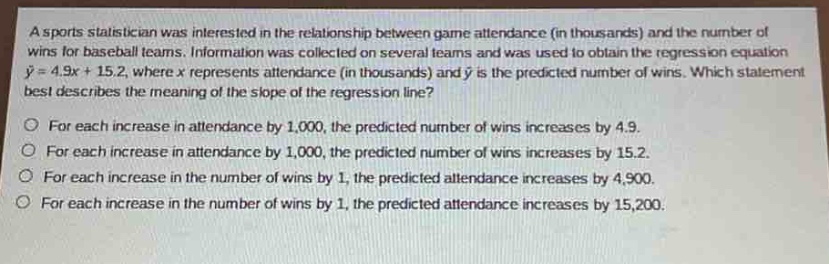
a sports statistician was interested in the relationship between game attendance (in thousands) and the number of wins for baseball teams. information was collected on several teams and was used to obtain the regression equation $hat{y}=4.9x + 15.2$, where $x$ represents attendance (in thousands) and $hat{y}$ is the predicted number of wins. which statement best describes the meaning of the slope of the regression line?\nfor each increase in attendance by 1,000, the predicted number of wins increases by 4.9.\nfor each increase in attendance by 1,000, the predicted number of wins increases by 15.2.\nfor each increase in the number of wins by 1, the predicted attendance increases by 4,900.\nfor each increase in the number of wins by 1, the predicted attendance increases by 15,200.
Answer
Answer:
A. For each increase in attendance by 1,000, the predicted number of wins increases by 4.9.
Explanation:
Step1: Identify the regression - equation form
The regression equation is $\hat{y}=4.9x + 15.2$, which is in the form $\hat{y}=mx + b$ where $m$ is the slope and $b$ is the y - intercept.
Step2: Interpret the slope
In the context of the problem, $x$ represents attendance (in thousands) and $\hat{y}$ represents the predicted number of wins. The slope $m = 4.9$. This means that for every one - unit increase in $x$ (since $x$ is in thousands, a one - unit increase in $x$ means an increase in attendance by 1,000), the predicted value of $\hat{y}$ (number of wins) increases by 4.9.