a standard deck of 52 cards contains four suits: hearts, diamonds, clubs, and spades. each suit has 13…
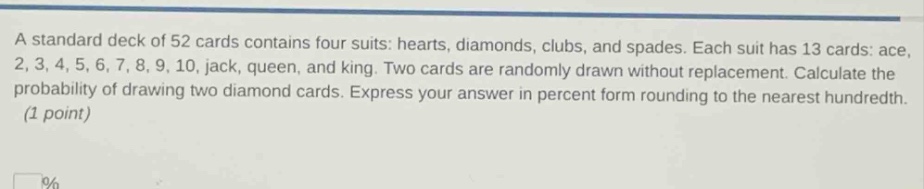
a standard deck of 52 cards contains four suits: hearts, diamonds, clubs, and spades. each suit has 13 cards: ace, 2, 3, 4, 5, 6, 7, 8, 9, 10, jack, queen, and king. two cards are randomly drawn without replacement. calculate the probability of drawing two diamond cards. express your answer in percent form rounding to the nearest hundredth. (1 point)
Answer
Explanation:
Step1: Calculate first - draw probability
The probability of drawing a diamond on the first draw is the number of diamond cards divided by the total number of cards. There are 13 diamond cards in a 52 - card deck. So the probability $P_1=\frac{13}{52}=\frac{1}{4}$.
Step2: Calculate second - draw probability
Since we do not replace the first - drawn card, for the second draw, there are 12 diamond cards left and 51 cards left in total. So the probability of drawing a diamond on the second draw given that a diamond was drawn on the first draw is $P_2 = \frac{12}{51}$.
Step3: Calculate the probability of both events
By the multiplication rule for dependent events, the probability of drawing two diamond cards is $P = P_1\times P_2=\frac{13}{52}\times\frac{12}{51}=\frac{13\times12}{52\times51}=\frac{156}{2652}=\frac{1}{17}\approx0.0588$.
Step4: Convert to percentage
To convert the probability to a percentage, we multiply by 100. So $0.0588\times100 = 5.88%$.
Answer:
$5.88%$