in a standard deck of cards there are 13 spades, 13 clubs, 13 hearts, and 13 diamonds. the spades and the…
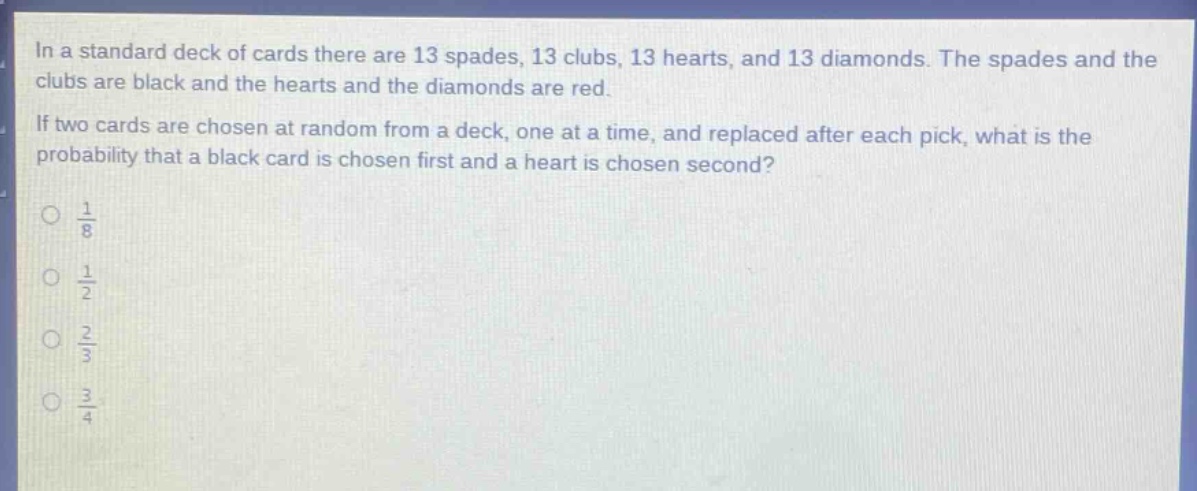
in a standard deck of cards there are 13 spades, 13 clubs, 13 hearts, and 13 diamonds. the spades and the clubs are black and the hearts and the diamonds are red. if two cards are chosen at random from a deck, one at a time, and replaced after each pick, what is the probability that a black card is chosen first and a heart is chosen second?\n\\(\\frac{1}{8}\\)\n\\(\\frac{1}{2}\\)\n\\(\\frac{2}{3}\\)\n\\(\\frac{3}{4}\\)
Answer
Explanation:
Step1: Calculate probability of black card
There are 26 black cards in a 52 - card deck. Probability of choosing a black card $P(B)=\frac{26}{52}=\frac{1}{2}$.
Step2: Calculate probability of heart card
There are 13 hearts in a 52 - card deck. Probability of choosing a heart card $P(H)=\frac{13}{52}=\frac{1}{4}$.
Step3: Use multiplication rule for independent events
Since the picks are independent (cards are replaced), the probability of both events occurring is $P = P(B)\times P(H)$. $P=\frac{1}{2}\times\frac{1}{4}=\frac{1}{8}$.
Answer:
$\frac{1}{8}$