for a standard normal distribution, find the approximate value of p(z≥ - 1.25). use the portion of the…
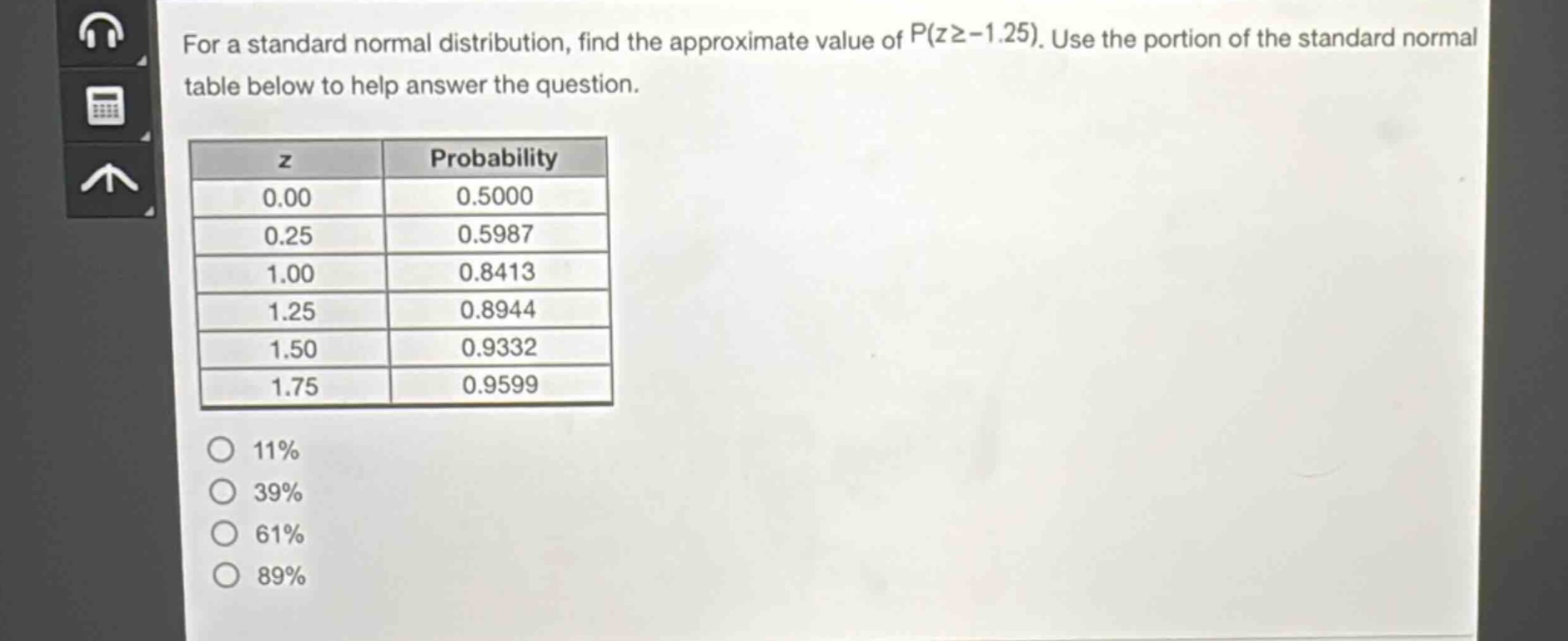
for a standard normal distribution, find the approximate value of p(z≥ - 1.25). use the portion of the standard normal table below to help answer the question.\n| z | probability |\n|----|----| \n| 0.00 | 0.5000 |\n| 0.25 | 0.5987 |\n| 1.00 | 0.8413 |\n| 1.25 | 0.8944 |\n| 1.50 | 0.9332 |\n| 1.75 | 0.9599 |\n11%\n39%\n61%\n89%
Answer
Explanation:
Step1: Use symmetry of normal distribution
The standard - normal distribution is symmetric about (z = 0). We know that (P(z\geq - 1.25)=1 - P(z\lt - 1.25)). And (P(z\lt - 1.25)=P(z\gt1.25)) due to symmetry. Also, (P(z\gt1.25)=1 - P(z\leq1.25)).
Step2: Look up value in table
From the standard - normal table, when (z = 1.25), (P(z\leq1.25)=0.8944).
Step3: Calculate (P(z\geq - 1.25))
(P(z\geq - 1.25)=1 - P(z\lt - 1.25)=1-(1 - P(z\leq1.25))=P(z\leq1.25)=0.8944\approx89%)
Answer:
89%