for a standard normal distribution, which of the following expressions must always be equal to…
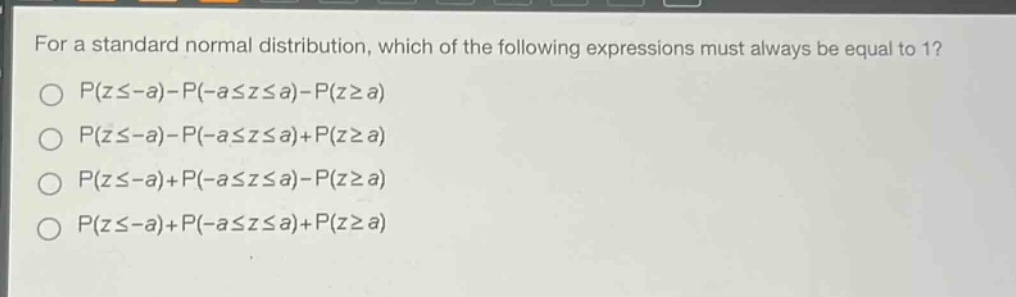
for a standard normal distribution, which of the following expressions must always be equal to 1?\np(z≤-a)-p(-a≤z≤a)-p(z≥a)\np(z≤-a)-p(-a≤z≤a)+p(z≥a)\np(z≤-a)+p(-a≤z≤a)-p(z≥a)\np(z≤-a)+p(-a≤z≤a)+p(z≥a)
Answer
Explanation:
Step1: Recall properties of standard normal
The entire area under the standard - normal curve is 1. The standard normal distribution is symmetric about (z = 0). The area of the entire distribution can be partitioned into three non - overlapping regions: (z\leq - a), (-a\leq z\leq a), and (z\geq a).
Step2: Analyze the sum of probabilities
The sum of the probabilities of these three non - overlapping regions gives the total probability of the entire sample space. That is, (P(z\leq - a)+P(-a\leq z\leq a)+P(z\geq a)=1).
Answer:
(P(z\leq - a)+P(-a\leq z\leq a)+P(z\geq a))