state gasoline taxes a random sample of state gasoline taxes (in cents) is shown here for 8 states. round…
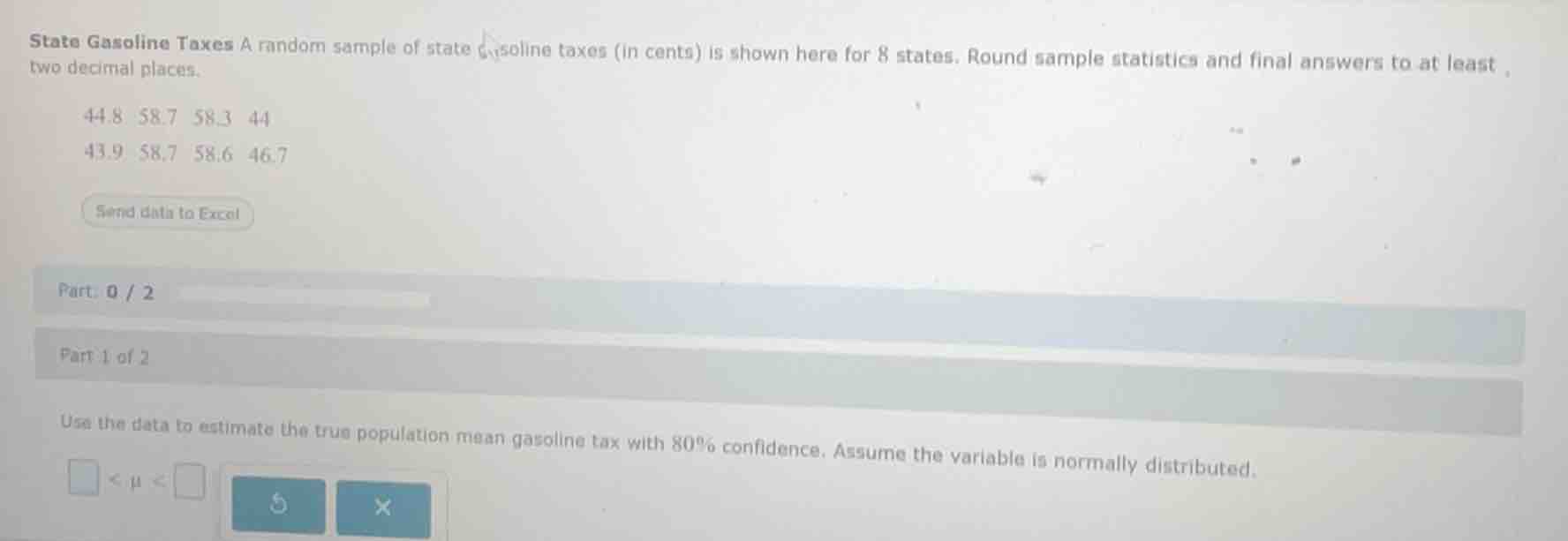
state gasoline taxes a random sample of state gasoline taxes (in cents) is shown here for 8 states. round sample statistics and final answers to at least two decimal places.\n\n44.8 58.7 58.3 44\n43.9 58.7 58.6 46.7\n\npart 1 of 2\nuse the data to estimate the true population mean gasoline tax with 80% confidence. assume the variable is normally distributed.\n\n$\\square < \\mu < \\square$
Answer
Explanation:
Step1: List the sample data and count observations
The sample data is: $44.8, 58.7, 58.3, 44, 43.9, 58.7, 58.6, 46.7$. The sample size is $n = 8$.
Step2: Calculate the sample mean
$$\bar{x} = \frac{\sum x_i}{n} = \frac{44.8 + 58.7 + 58.3 + 44 + 43.9 + 58.7 + 58.6 + 46.7}{8} = \frac{413.7}{8} = 51.7125$$
Step3: Calculate the sample standard deviation
$$s = \sqrt{\frac{\sum (x_i - \bar{x})^2}{n-1}} \approx \sqrt{\frac{355.14875}{7}} \approx 6.7136$$
Step4: Determine the critical t-value
For $80%$ confidence and $df = n - 1 = 7$, the critical value $t_{\alpha/2}$ is: $$t_{0.10, 7} \approx 1.415$$
Step5: Calculate the margin of error
$$E = t_{\alpha/2} \cdot \left(\frac{s}{\sqrt{n}}\right) = 1.415 \cdot \left(\frac{6.7136}{\sqrt{8}}\right) \approx 1.415 \cdot 2.3736 \approx 3.3587$$
Step6: Construct the confidence interval
$$\text{Lower limit} = \bar{x} - E = 51.7125 - 3.3587 = 48.3538$$ $$\text{Upper limit} = \bar{x} + E = 51.7125 + 3.3587 = 55.0712$$
Answer:
$48.35 < \mu < 55.07$