which statement below correctly depicts the expected value of a fair game?\no e(x) = 0\no e(x) = 1\no e(x) >…
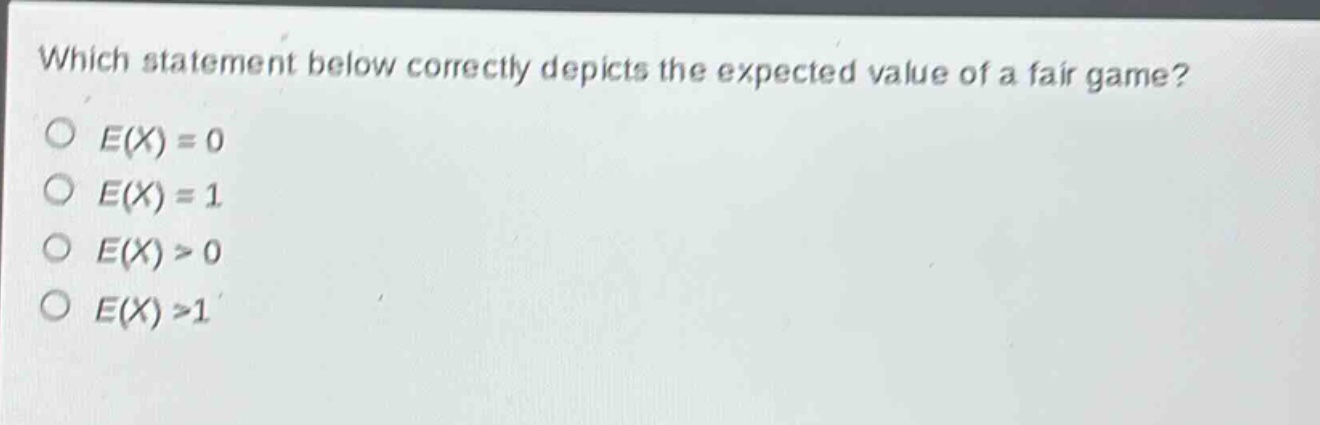
which statement below correctly depicts the expected value of a fair game?\no e(x) = 0\no e(x) = 1\no e(x) > 0\no e(x) >1
Answer
Explanation:
Step1: Recall fair - game concept
In a fair game, on average, a player neither wins nor loses. The expected value $E(X)$ represents the average outcome of a random variable $X$.
Step2: Determine expected - value
If a player neither wins nor loses on average, the expected value of the game is 0. That is, the sum of the products of each possible outcome and its probability results in 0.
Answer:
$E(X)=0$