which statement is true about whether c and y are independent events? c and y are independent events because…
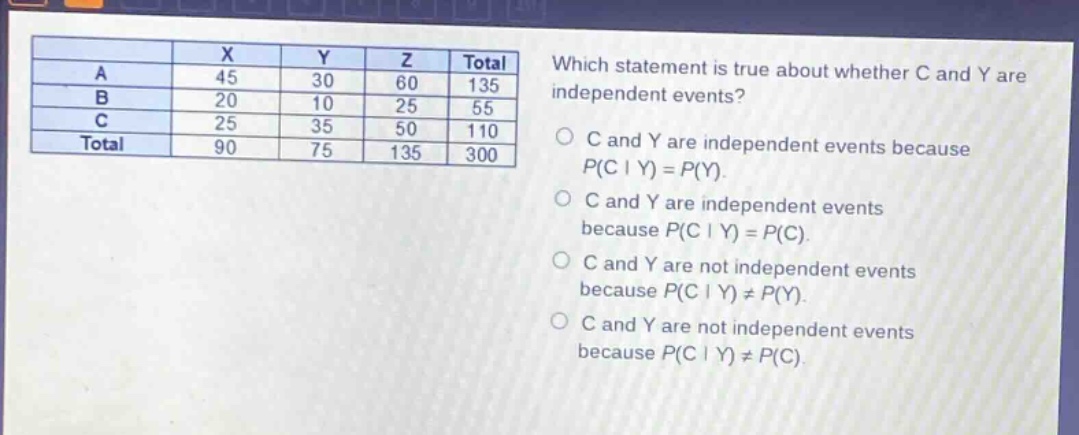
which statement is true about whether c and y are independent events? c and y are independent events because p(c | y) = p(y). c and y are independent events because p(c | y) = p(c). c and y are not independent events because p(c | y) ≠ p(y). c and y are not independent events because p(c | y) ≠ p(c).
Answer
Explanation:
Step1: Recall the definition of independent events
Two events (C) and (Y) are independent if (P(C|Y)=P(C)). The formula for conditional - probability is (P(C|Y)=\frac{P(C\cap Y)}{P(Y)}).
Step2: Calculate (P(C))
The total number of outcomes is (n = 300). The number of elements in event (C) is (n(C)=55). So, (P(C)=\frac{n(C)}{n}=\frac{55}{300}=\frac{11}{60}).
Step3: Calculate (P(C\cap Y))
From the table, the number of elements in (C\cap Y) is (n(C\cap Y) = 10). So, (P(C\cap Y)=\frac{n(C\cap Y)}{n}=\frac{10}{300}=\frac{1}{30}).
Step4: Calculate (P(Y))
The number of elements in event (Y) is (n(Y)=75). So, (P(Y)=\frac{n(Y)}{n}=\frac{75}{300}=\frac{1}{4}).
Step5: Calculate (P(C|Y))
Using the formula (P(C|Y)=\frac{P(C\cap Y)}{P(Y)}), substitute (P(C\cap Y)=\frac{1}{30}) and (P(Y)=\frac{1}{4}). Then (P(C|Y)=\frac{\frac{1}{30}}{\frac{1}{4}}=\frac{4}{30}=\frac{2}{15}). Since (\frac{2}{15}\neq\frac{11}{60}), i.e., (P(C|Y)\neq P(C)).
Answer:
C and Y are not independent events because (P(C|Y)\neq P(C)).