which statement is true about whether z and b are independent events?\nz and b are independent events…
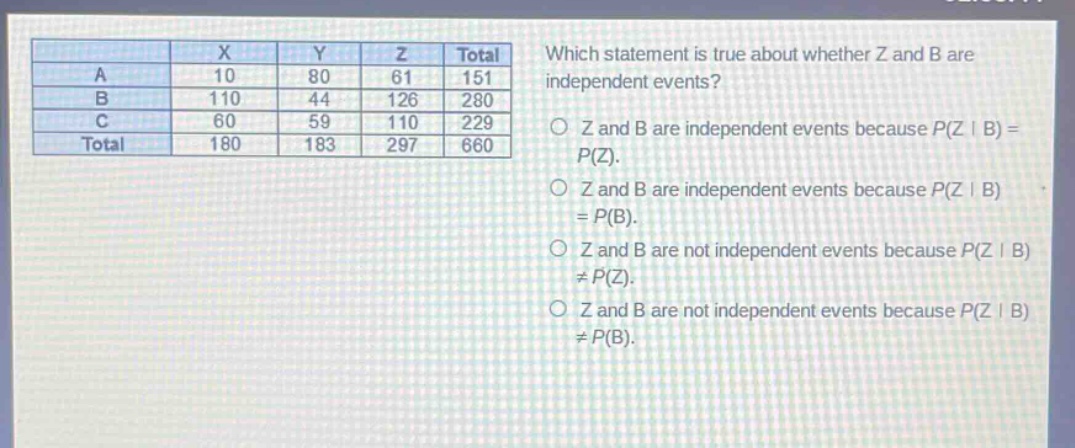
which statement is true about whether z and b are independent events?\nz and b are independent events because p(z | b)=p(z).\nz and b are independent events because p(z | b)=p(b).\nz and b are not independent events because p(z | b)≠p(z).\nz and b are not independent events because p(z | b)≠p(b).
Answer
Explanation:
Step1: Recall the definition of independent events
Two events (Z) and (B) are independent if (P(Z|B)=P(Z)). The formula for conditional - probability is (P(Z|B)=\frac{P(Z\cap B)}{P(B)}).
Step2: Calculate (P(Z))
The total number of outcomes is (n = 660). The number of times event (Z) occurs is (n_Z=297). So, (P(Z)=\frac{297}{660}=\frac{9}{20}=0.45).
Step3: Calculate (P(Z\cap B)) and (P(B))
The number of times (Z) and (B) occur together is (n_{Z\cap B}=126), so (P(Z\cap B)=\frac{126}{660}=\frac{21}{110}). The number of times event (B) occurs is (n_B = 280), so (P(B)=\frac{280}{660}=\frac{14}{33}).
Step4: Calculate (P(Z|B))
Using the formula (P(Z|B)=\frac{P(Z\cap B)}{P(B)}), we substitute the values: (P(Z|B)=\frac{\frac{126}{660}}{\frac{280}{660}}=\frac{126}{280}=\frac{9}{20}=0.45). Since (P(Z|B) = P(Z)=\frac{9}{20}), (Z) and (B) are independent events.
Answer:
Z and B are independent events because (P(Z|B)=P(Z)).