which statements are true about the interquartile range? select all that apply. subtract the lowest and…
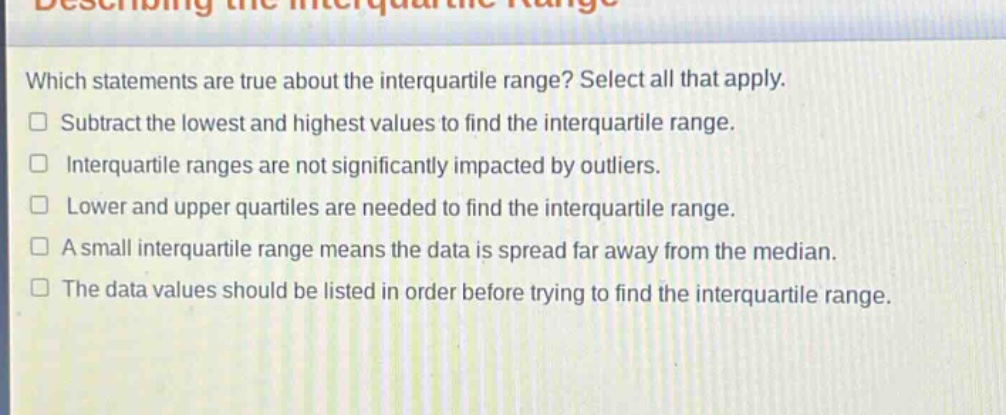
which statements are true about the interquartile range? select all that apply. subtract the lowest and highest values to find the interquartile range. interquartile ranges are not significantly impacted by outliers. lower and upper quartiles are needed to find the interquartile range. a small interquartile range means the data is spread far away from the median. the data values should be listed in order before trying to find the interquartile range.
Answer
Brief Explanations:
- The inter - quartile range (IQR) is found by subtracting the lower quartile ($Q_1$) from the upper quartile ($Q_2$), not the lowest and highest values, so the first statement is false.
- Since the IQR is based on the middle 50% of the data, outliers (extreme values) do not significantly impact it, so the second statement is true.
- As mentioned, $IQR = Q_3 - Q_1$, so lower and upper quartiles are needed, and the third statement is true.
- A small IQR means the middle 50% of the data is clustered closely around the median, not spread far away, so the fourth statement is false.
- To find quartiles, the data must be ordered first, so the fifth statement is true.
Answer:
B. Interquartile ranges are not significantly impacted by outliers. C. Lower and upper quartiles are needed to find the interquartile range. E. The data values should be listed in order before trying to find the interquartile range.