station 4 | supporting claims using data | sc.8.n.1.1\na student is given a ruler and a hand lens and asked…
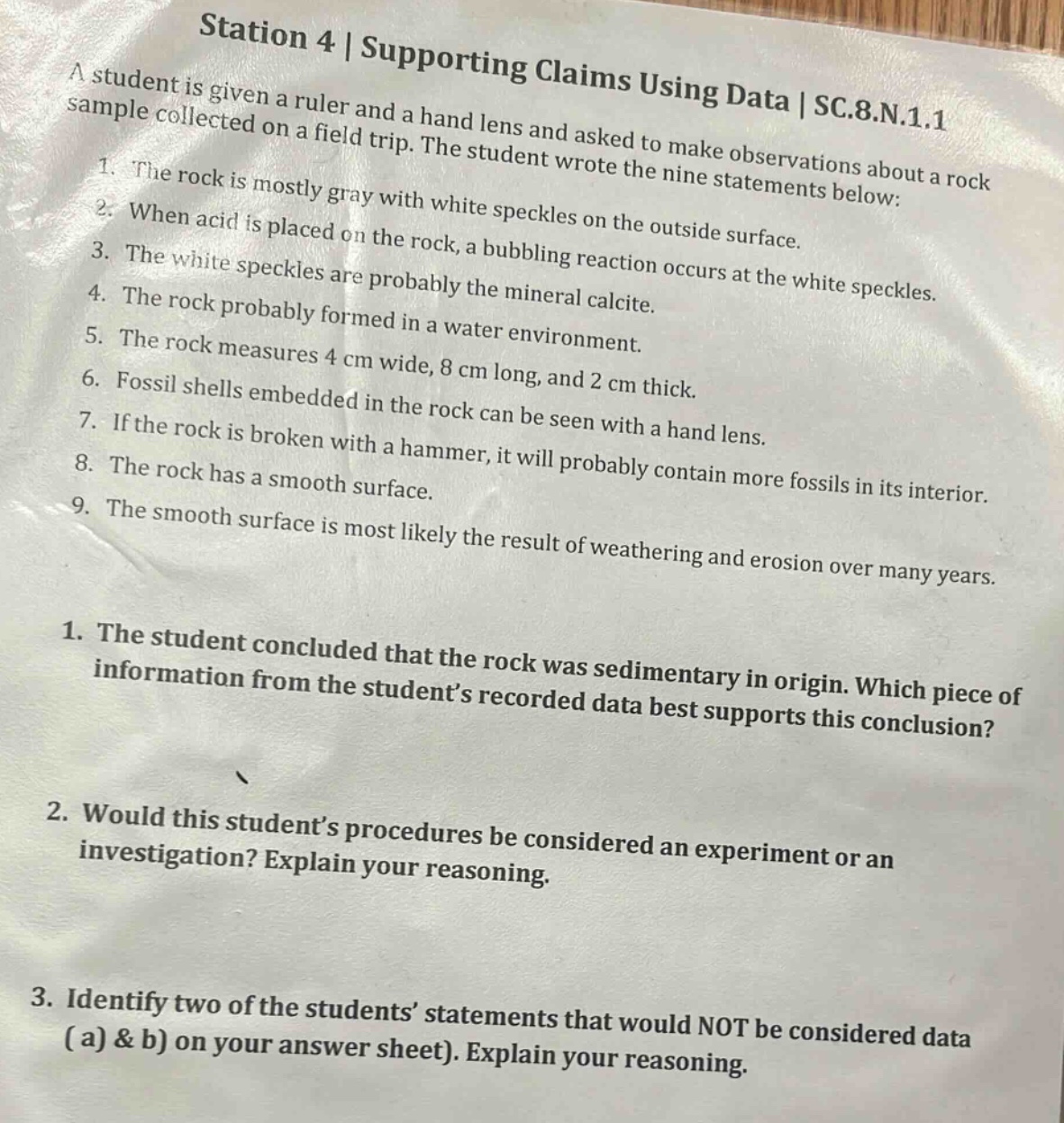
station 4 | supporting claims using data | sc.8.n.1.1\na student is given a ruler and a hand lens and asked to make observations about a rock sample collected on a field trip. the student wrote the nine statements below:\n1. the rock is mostly gray with white speckles on the outside surface.\n2. when acid is placed on the rock, a bubbling reaction occurs at the white speckles.\n3. the white speckles are probably the mineral calcite.\n4. the rock probably formed in a water environment.\n5. the rock measures 4 cm wide, 8 cm long, and 2 cm thick.\n6. fossil shells embedded in the rock can be seen with a hand lens.\n7. if the rock is broken with a hammer, it will probably contain more fossils in its interior.\n8. the rock has a smooth surface.\n9. the smooth surface is most likely the result of weathering and erosion over many years.\n1. the student concluded that the rock was sedimentary in origin. which piece of information from the student’s recorded data best supports this conclusion?\n2. would this student’s procedures be considered an experiment or an investigation? explain your reasoning.\n3. identify two of the students’ statements that would not be considered data (a) & b) on your answer sheet). explain your reasoning.
Answer
Brief Explanations:
- Sedimentary rocks often contain fossils. The presence of fossil shells embedded in the rock (Statement 6) is strong evidence for a sedimentary origin as fossils are commonly found in sediment - deposited environments.
- This is an investigation. The student is making observations about a rock sample using tools like a ruler and hand - lens, but there is no controlled variable or manipulation to test a hypothesis as in an experiment.
- Statements 4 ("The white speckles are probably the mineral calcite.") and 5 ("The rock probably formed in a water environment.") are not data. They are inferences or hypotheses. Data are observable and measurable facts, while these statements involve speculation based on observations rather than direct measurements or observations.
Answer:
- Statement 6: Fossil shells embedded in the rock can be seen with a hand lens.
- Investigation. Reason: No controlled variable or manipulation to test a hypothesis; just making observations.
- a. Statement 4: It is an inference about the mineral composition, not direct data. b. Statement 5: It is a speculation about the formation environment, not direct data.