the store owner converts the frequency table to a conditional relative frequency table by row.\nbeach towel…
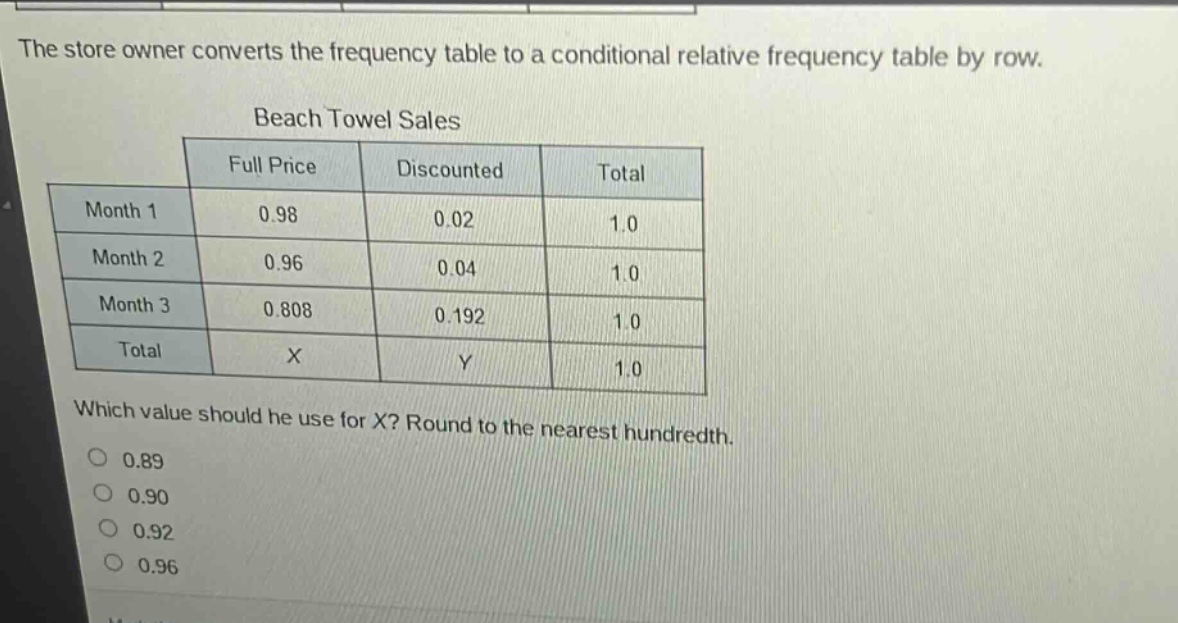
the store owner converts the frequency table to a conditional relative frequency table by row.\nbeach towel sales\n| |full price|discounted|total|\n|----|----|----|----|\n|month 1|0.98|0.02|1.0|\n|month 2|0.96|0.04|1.0|\n|month 3|0.808|0.192|1.0|\n|total|x|y|1.0|\nwhich value should he use for x? round to the nearest hundredth.\n0.89\n0.90\n0.92\n0.96
Answer
Explanation:
Step1: Recall the concept of column - total in conditional relative frequency table
In a conditional relative frequency table by row, to find the column - total for the "Full Price" column, we sum the conditional relative frequencies in that column for each row.
Step2: Calculate the sum
We have (0.98 + 0.96+0.808). [0.98+0.96 + 0.808=(0.98+0.96)+0.808 = 1.94+0.808=2.748] Since these are relative frequencies, we need to divide by the number of rows (3 in this case) to get the overall relative frequency for the column. (\frac{0.98 + 0.96+0.808}{3}=\frac{2.748}{3}=0.916\approx0.92)
Answer:
0.92