the store owner converts the frequency table to a conditional relative frequency table by row.\nbeach towel…
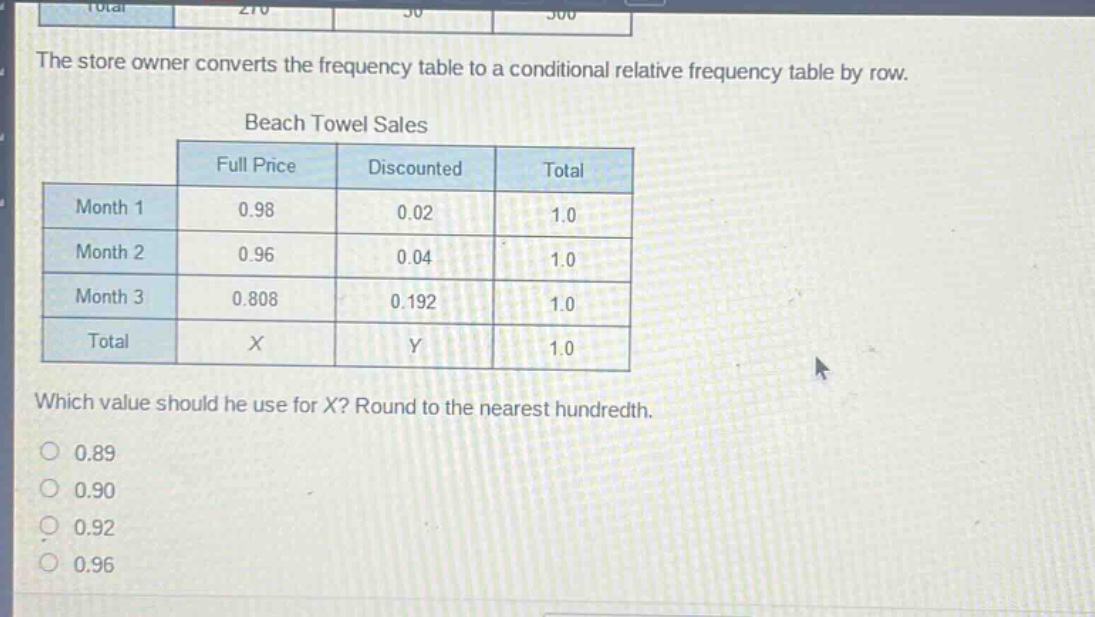
the store owner converts the frequency table to a conditional relative frequency table by row.\nbeach towel sales\n| |full price|discounted|total|\n|--|--|--|--|\n|month 1|0.98|0.02|1.0|\n|month 2|0.96|0.04|1.0|\n|month 3|0.808|0.192|1.0|\n|total|x|y|1.0|\nwhich value should he use for x? round to the nearest hundredth.\n0.89\n0.90\n0.92\n0.96
Answer
Explanation:
Step1: Recall the concept of row - conditional relative frequency
To find the value of (X) (the total of the full - price column in the row - conditional relative frequency table), we need to take the weighted average of the full - price conditional relative frequencies for each month. Assume the number of sales in month 1, month 2, and month 3 are (n_1), (n_2), and (n_3) respectively. But since we are dealing with relative frequencies, we can also calculate it as follows. Let's assume equal weights for simplicity (if we consider the relative importance of each month's data). We have three months of data. We calculate the average of the full - price conditional relative frequencies for each month: (\frac{0.98 + 0.96+0.808}{3}).
Step2: Perform the calculation
[ \begin{align*} \frac{0.98 + 0.96+0.808}{3}&=\frac{2.748}{3}\ & = 0.916 \end{align*} ] Rounding 0.916 to the nearest hundredth gives 0.92.
Answer:
0.92