in which story could you use the quotient $-30 \\div 6$ to answer the question?\nfrom january to july, the…
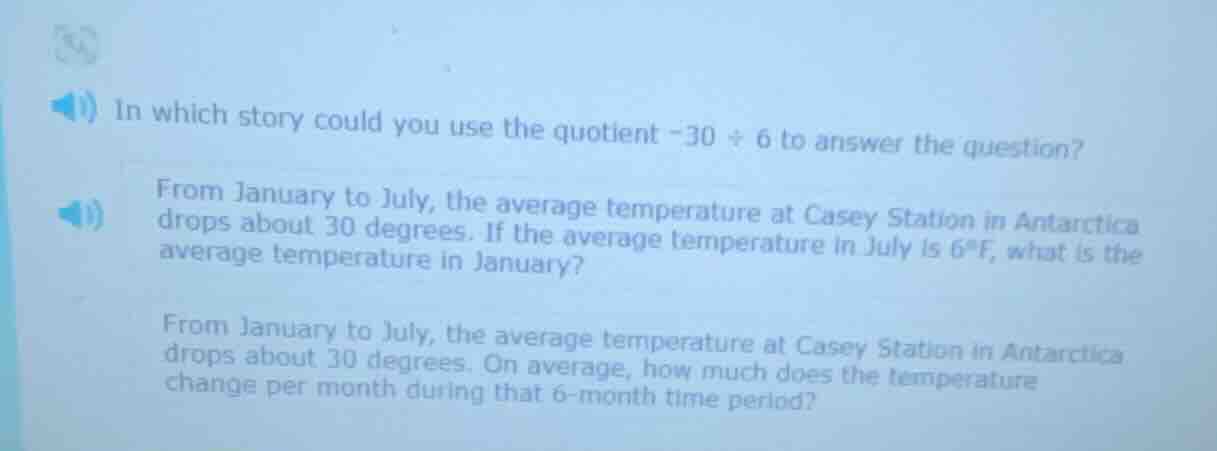
in which story could you use the quotient $-30 \\div 6$ to answer the question?\nfrom january to july, the average temperature at casey station in antarctica drops about 30 degrees. if the average temperature in july is 6°f, what is the average temperature in january?\nfrom january to july, the average temperature at casey station in antarctica drops about 30 degrees. on average, how much does the temperature change per month during that 6-month time period?
Answer
Explanation:
Step1: Analyze first scenario
The first question asks for January's temperature, which would use addition ($6 + 30$), not division.
Step2: Analyze second scenario
The second question calculates monthly temperature change over 6 months with a total drop of 30 degrees. A temperature drop is represented as -30, so we divide by 6: $\frac{-30}{6}$
Answer:
From January to July, the average temperature at Casey Station in Antarctica drops about 30 degrees. On average, how much does the temperature change per month during that 6-month time period?