a student claims that professional male basketball players are taller, on average, than college male…
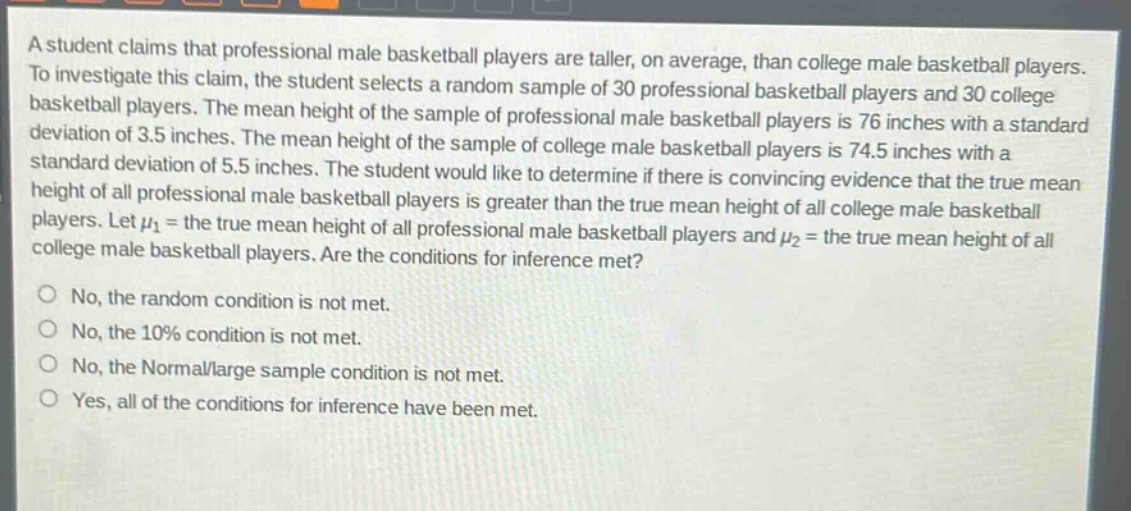
a student claims that professional male basketball players are taller, on average, than college male basketball players. to investigate this claim, the student selects a random sample of 30 professional basketball players and 30 college basketball players. the mean height of the sample of professional male basketball players is 76 inches with a standard deviation of 3.5 inches. the mean height of the sample of college male basketball players is 74.5 inches with a standard deviation of 5.5 inches. the student would like to determine if there is convincing evidence that the true mean height of all professional male basketball players is greater than the true mean height of all college male basketball players. let $mu_1$ = the true mean height of all professional male basketball players and $mu_2$ = the true mean height of all college male basketball players. are the conditions for inference met?\nno, the random condition is not met.\nno, the 10% condition is not met.\nno, the normal/large sample condition is not met.\nyes, all of the conditions for inference have been met.
Answer
Explanation:
Step1: Check random condition
The student selects a random sample of 30 professional and 30 college basketball players. So the random condition is met.
Step2: Check 10% condition
There are many professional and college basketball players. A sample of 30 from each group is likely less than 10% of the total population of each group. So the 10% condition is met.
Step3: Check Normal/large - sample condition
Both sample sizes (n_1 = n_2=30). By the Central Limit Theorem, for sample sizes of 30 or more, the sampling distribution of the difference in sample means is approximately normal. So the Normal/large - sample condition is met.
Answer:
Yes, all of the conditions for inference have been met.